In March of this year I bought a used Meta Quest 2 virtual reality headset off eBay for $150 because a friend of mine pointed out I could buy a used Quest 2 off eBay for $150 and use it to be some kind of virtual lizard critter.
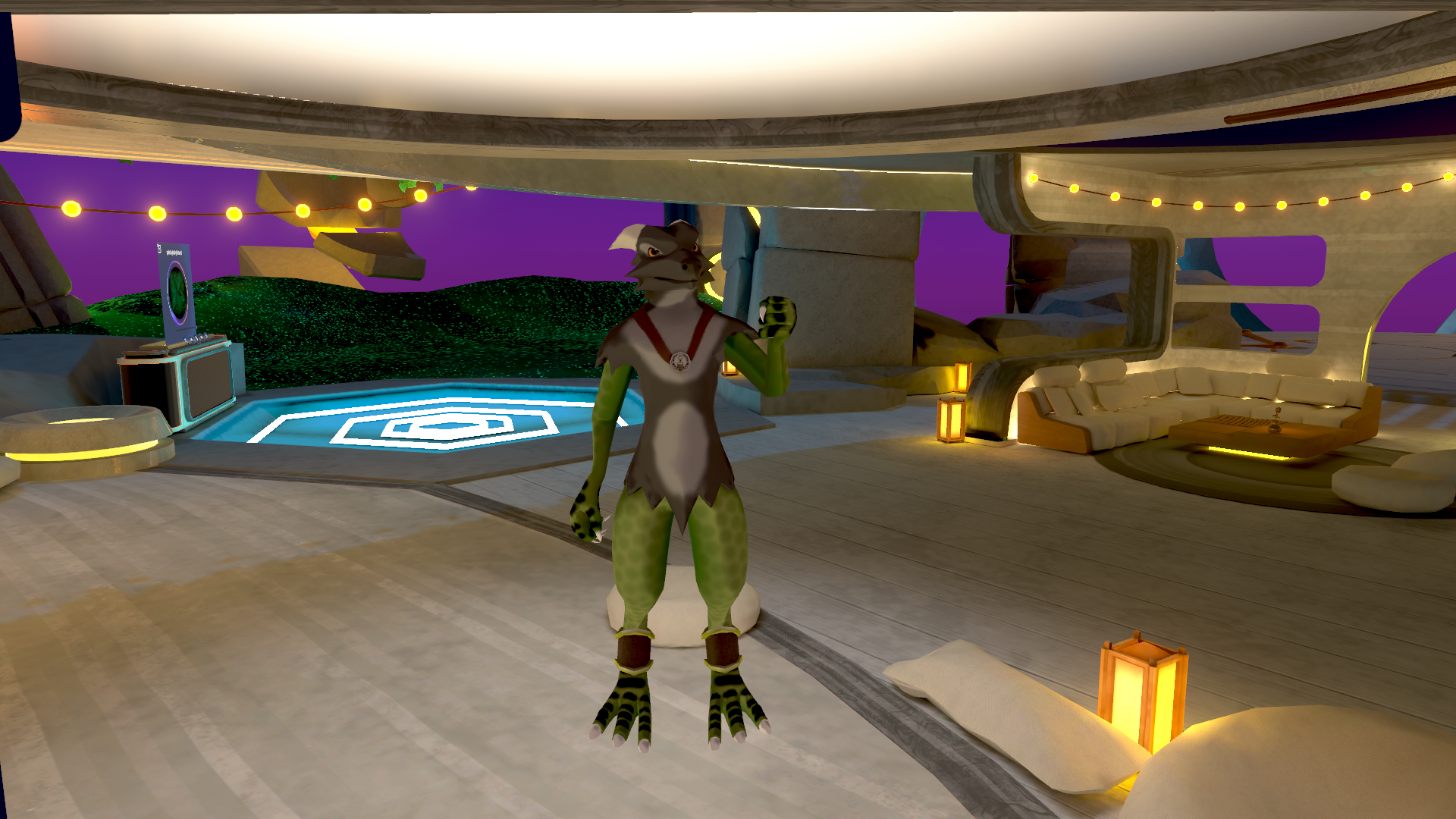
Verdict: true. Then for some reason I never actually did anything with it. I spent about two hours finding that avatar and looking at myself in the mirror in the default VRChat world, found being some kind of virtual lizard critter to be quite enjoyable, and then I put the headset away and didn't use it again for a while. I didn't even get to the point of talking to another person in VRChat.
Anyways, the other day I decided I'd better figure out how this stuff actually works so I could get back in touch with a friend who seems to have made VRChat their primary form of online social interaction. Long story short, I've put 18 hours in on the game in the past week.
Long story long, "using VR for the first time in 2026" has been an interesting experience. My previous exposure to VR was divided roughly evenly between a) seeing my father purchase an early Oculus HMD around 2017, use it to play Beat Saber a few times, and put it in the closet, b) Meta's unsuccessful attempt to make Horizon Worlds a thing in 2022 spilling out into online spaces I was already part of, and c) Dan Olson's documentary The Future is a Dead Mall - Decentraland and the Metaverse, which primarily concerns "competing" cryptocurrency-focused platform Decentraland but also generally discusses how it's a stupid idea to try and make VR into a serious thing that normal people do. It hasn't been a flattering depiction of the technology.
And yet, within a few hours of getting the thing set back up, I was hanging out on a virtual beach with my old friend and four new friends and having a thoroughly good time. What gives?
Well, the important thing to note is that all the reasons why Horizon Worlds and similar projects didn't take off are still there. One of the first things I noticed is that weirdass avatar jank is so common as to be unremarkable; most of my friends have some level of full-body motion tracking set up, and the way that appears in the world is that their avatar hovers several feet off the ground in a reclining position because they're sitting on a bed or couch or something (apparently beanbag chairs are popular) in real life but no such affordance exists in the virtual world to match. Changing from seated to standing positions in real life to match the world would add verisimilitude, but it requires physical effort, is potentially hazardous because one's vision is obstructed by the HMD, and requires you to go into 3rd person and adjust things anyways because it's unlikely that the surface you're sitting on in VR is the same size as the surface you're sitting on in real life.
And it doesn't stop there. Full-body tracking uses a technique called "inverse kinematics" to map the physical locations of about eight tracked points onto the avatar's rig, and that means that if a player removes their trackers without exiting the game (to use the restroom, for instance) their avatar just kind of ends up crumpled into a ball until they strap back in. It's really strange the first time you see it, and then it becomes a normal part of the world. Reaching into another player's avatar while attempting to pick up your real-life beverage is a common subject of humor, since it's of course practical to place the beverage out of arm's reach when you're not using it. I have both said and heard "whoops, I just punched my keyboard / desk / water glass / mic stand" more times than I can count.
To round things out, wearing a HMD for long periods of time is uncomfortable (especially if, like mine, the battery does not last long enough for a full session and you need to keep it plugged in to the wall), the software itself is laggy and unreliable, and this is just the user experience. This is what you get if you get a headset, sign up, and exclusively use other people's in-game content. Who the heck would put up with this bullshit?
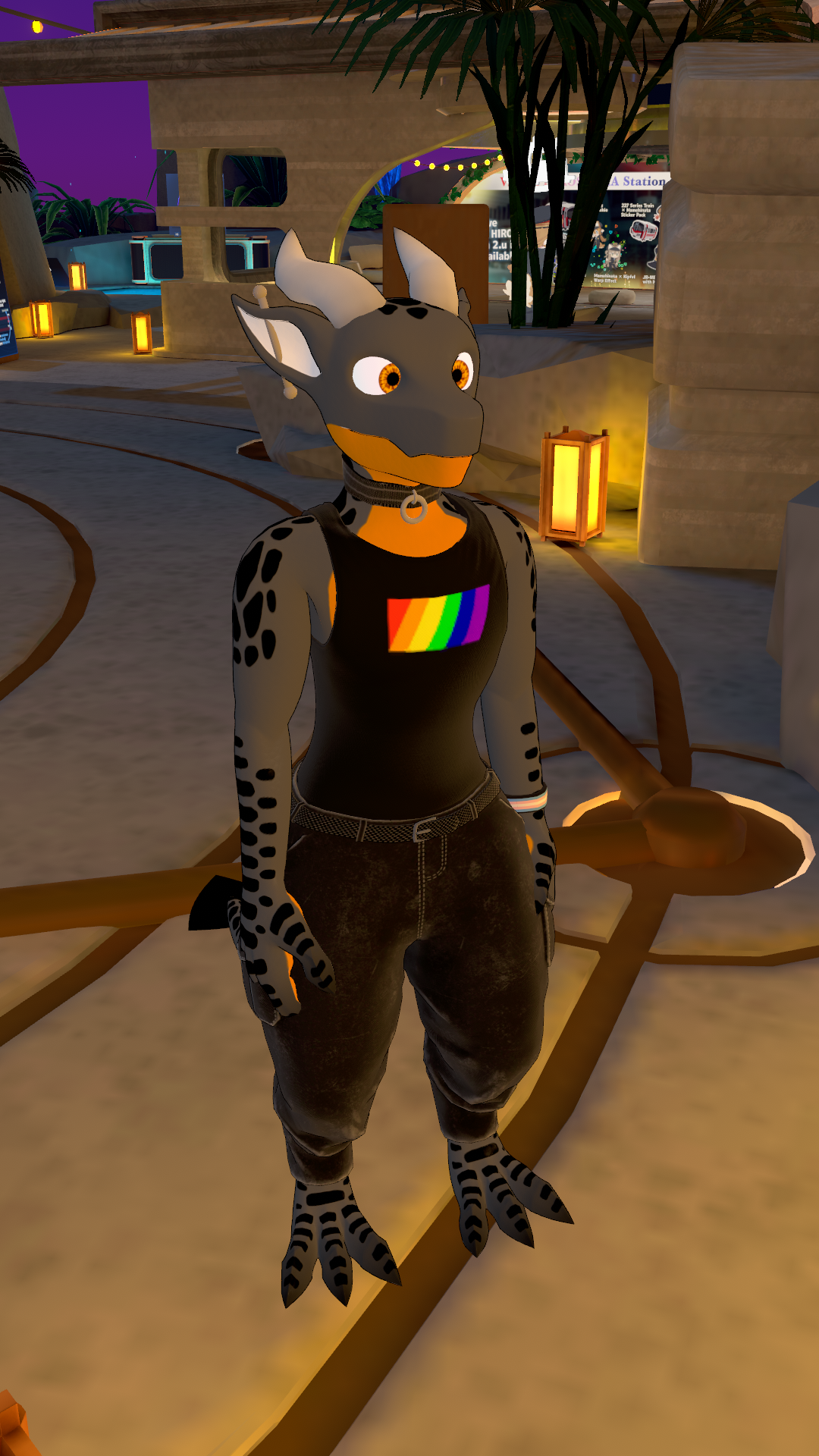
Well, me. The answer is, of course, people who's inherent need for a form of self-expression that's impossible in the real world is strong enough that they'll put up with all this crap. I found being able to interact with people using the base version of this avatar (not pictured) extremely satisfying and self-affirming, and immediately wanted to do more of it and figure out how to customize the model to better suit my tastes. Surely that's easy, right? I mean one of the things Meta et al. were trying to sell everyone on back in 2022 was that limitless self-expression through [checks notes] buying a virtual copy of your favorite T-shirt for about as much as the real T-shirt costs? We can do that, right?
I got twenty-six fucking years into my life without having to install Unity and it was all over in a second. When you customize a VRChat avatar, you are making a video game asset that is then going to be used in a video game. This gay little lizard is a miserable pile of textures, meshes, rigs, blend shapes, shaders, and inscrutable glue code, and what that means is the only way it changes is if I edit those pieces in the appropriate program (usually either Blender, Unity, or Krita) and reupload. You can't just drag-and-drop clothing onto an avatar because it turns out that conforming clothing models to fit arbitrary base avatars is really fucking hard, and I know because I've had to learn how to do it manually:
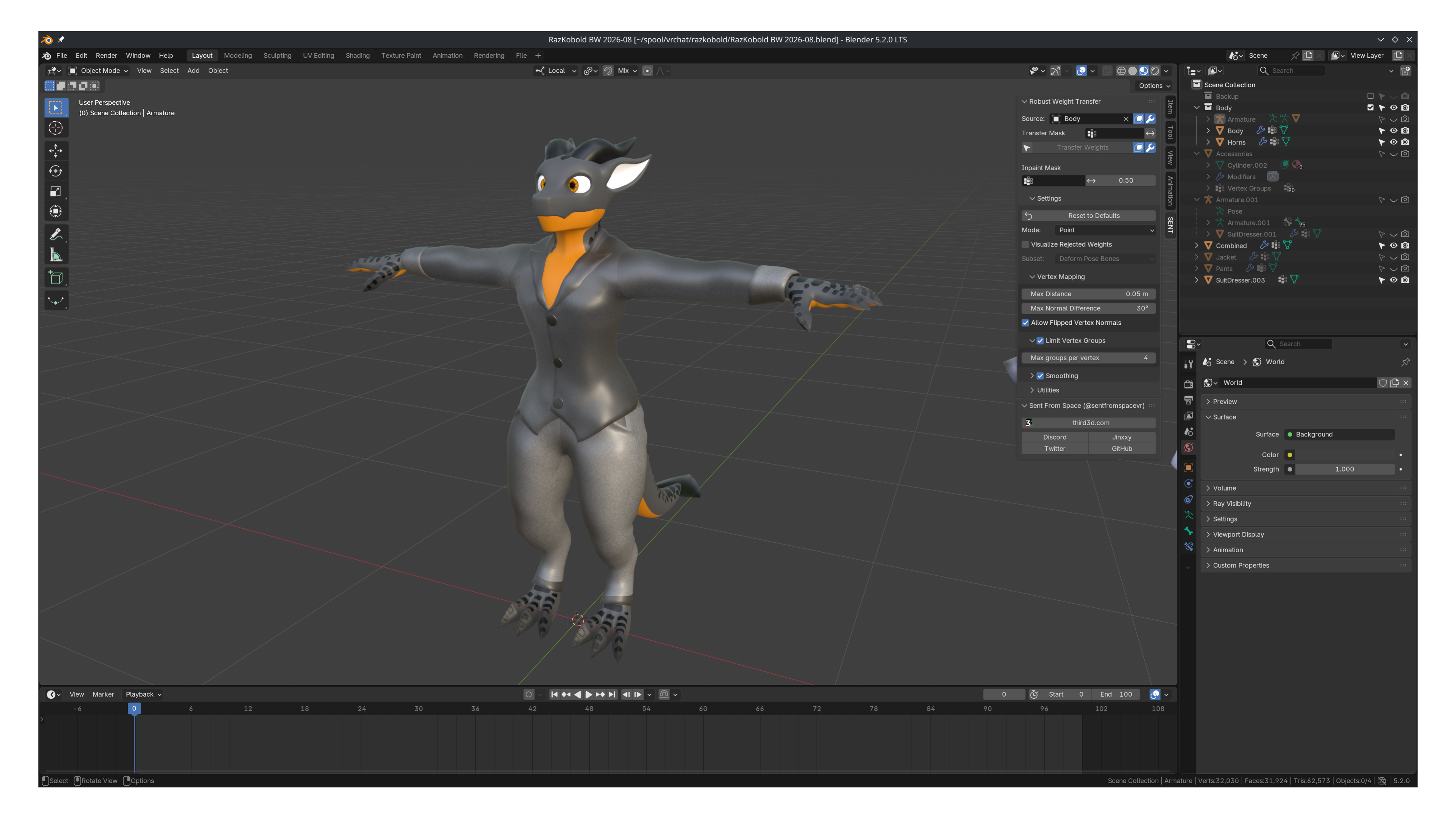
This suit jacket and pants were originally modeled to fit a slightly different furry avatar. Despite being roughly the same body shape, the rest position of the suit model didn't remotely match my little guy here, so I had to spend an hour in Blender's sculpt mode reshaping it. I'm literally doing my own digital tailoring. (It's kinda fun, actually. Being able to put the clothing mesh in wireframe mode so I can see how close it is to the body feels like cheating). Once I have it in the right shape, rigging it to match the movements of the body is just barely possible to do automatically, and I still had to spend some time putting the model in weird poses and tweaking the geometry so the body mesh didn't clip through. Turns out that we take it for granted that real-life clothing doesn't like to intersect with your body.
That's about the best case for adding clothing to an avatar, too, at least beyond the extremely rare case that someone has already modeled the piece you want to fit your specific avatar already. In real life, most humans are about the same size and shape relative to what's possible here; even in just the area of furry avatars you get digitigrade vs. plantigrade legs, tails, wings, horns, and people who enjoy using avatars with purposefully unrealistic proportions. One size very much does not fit all.
And, of course, after I did all that, the texture didn't import right into Unity so I decided it would be fun to put a non-photorealistic shader on it instead:
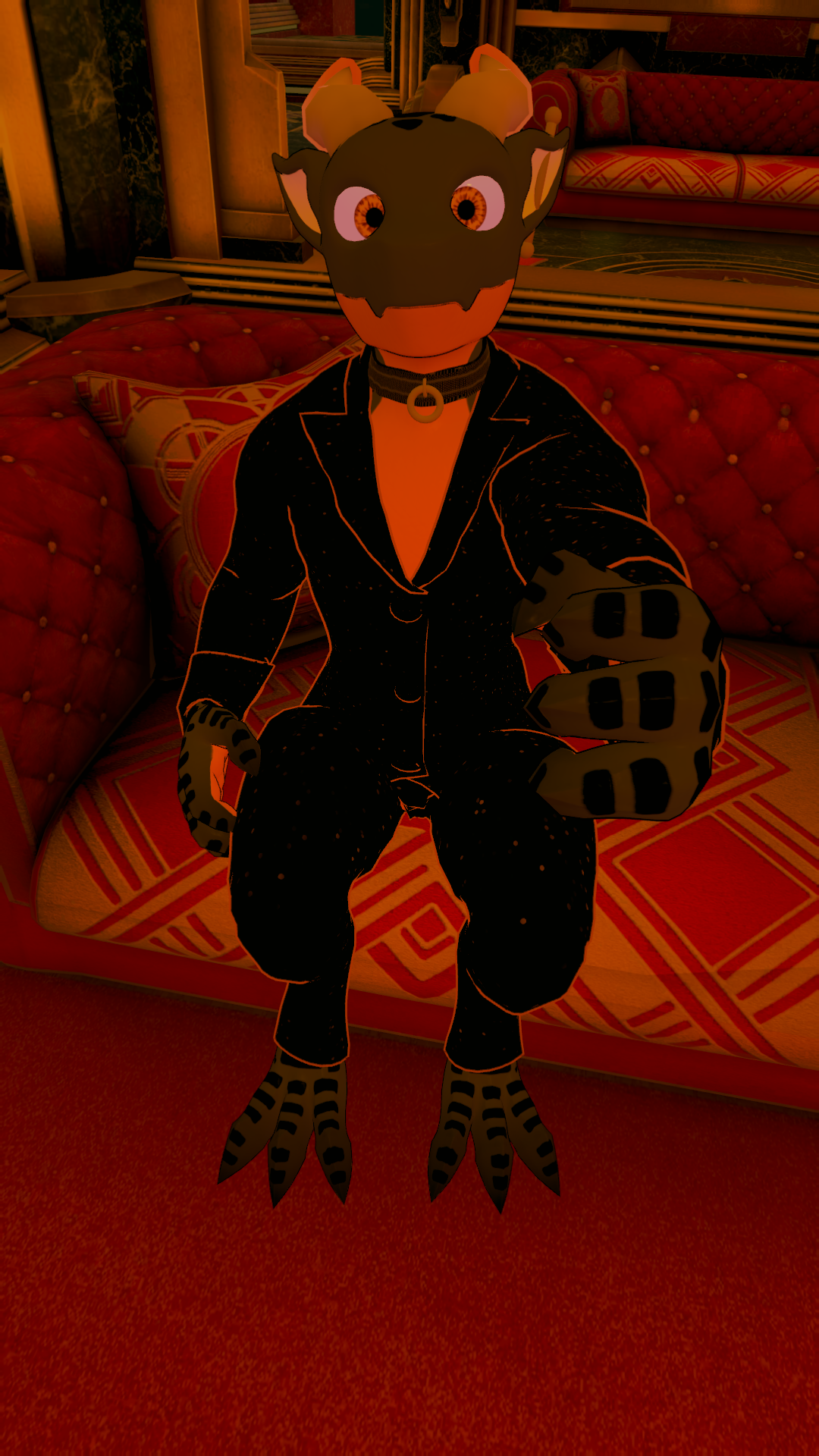
Which, y'know, that's pretty neat. It is really fun getting to do things like this that are only possible in a digital environment. One of my friend group's common hangout spots is a map called "Stage Flight", which is a meticulously-designed virtual concert venue with an elaborate lighting system. It's based off real-life stage lighting hardware, which has been meticulously modeled in the world (complete with fictitious branding on some of the effects units), gets programmed with a video file containing embedded DMX512 data, and in addition to your normal lighting board stuff lets you do things like command the lighting trusses to fly around the stage unbothered by physics -- although the notes for the world recommend that you model a realistic amount of acceleration and deceleration on them to represent that they're large, heavy objects. It's an amazing work of art that seems to have been the work of a dozen or so volunteer programmers and designers.
And, of course, the first couple times I tried to join that world, the download for the backing video file took up enough bandwidth on my computer's primary outbound WLAN connection that it interfered with the dedicated ~120 Mb/s wireless link I set up for the headset, shot my ping up to about 14,000 ms, and crashed the game. Eventually I figured out what was going on, moved the headset network to a different channel, and it hasn't been a problem since, but c'mon... one week into this thing and I've had to demonstrate or develop competence in network administration, 3D modeling, texturing, rigging, game asset optimization, and figuring out how to get all this software working on Linux. I was already pretty good at a lot of that stuff going in and it's still hard.
There's no goddamn way anyone's going to use this technology to its potential unless they're a very specific type of freak. And that's how it should be. It's beautiful.