So the other day I bought a new computer monitor. That meant I had to install it on my VESA mount monitor arm, which in turn reminded me that the screws said monitor arm came with are pretty terrible -- your usual cheap combination drive screw that strips if you look at it funny, and of course you're gonna be looking at it funny because it's behind the monitor and you've gotta get back there with the screwdriver and there's not so much space between it and the wall.
Presumably we've all had this kind of experience. On the one hand, it makes sense why it happens: even a cheap M4 screw can hold several times the weight of the monitor, and the monitor arm has four of them; they're also not something that you're going to be interacting with very often, so the manufacturer has no particular incentive to go for nice fasteners. Doesn't help that it's a pretty cheap monitor arm.
On the other hand, it pisses me off, because I have to deal with bad fasteners. The thing about fasteners in product design is that usually it's really, really obvious when you cheap out on them, and it makes the experience of doing anything with your product that involves those fasteners so much worse. I decided I wasn't gonna do that again (especially because I'm hopefully going to take this whole setup down again in a few months to move house), so I went to McMaster-Carr and ordered eight high-quality M4 thumbscrews and washers (one for each monitor). It's a big difference, and I'm sure I'm going to appreciate it when I move the setup and then later when I swap out the other monitor as well.
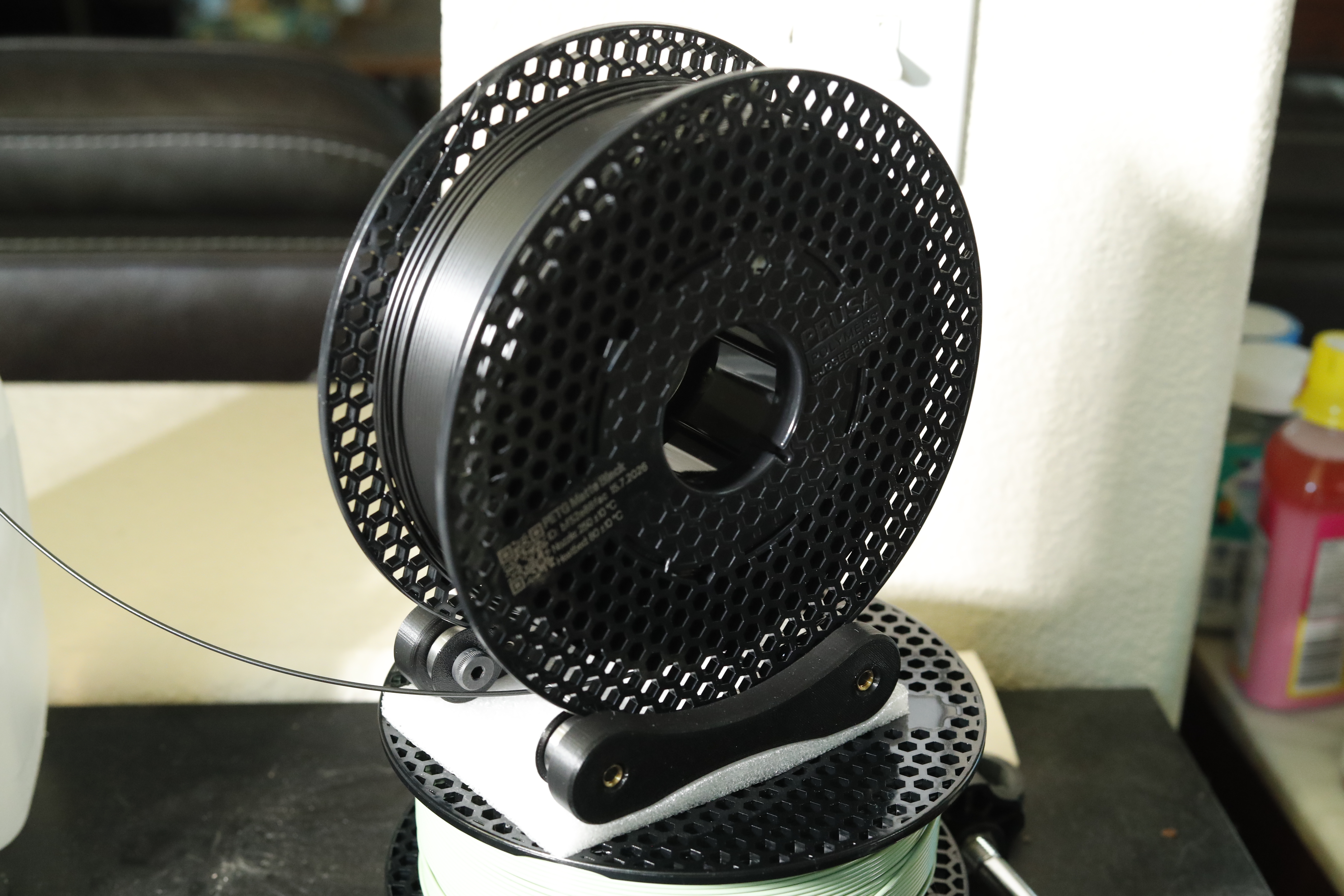
While I was putting that McMaster order together, though, I remembered that I really needed to do something about my 3D printer spool situation. For about a year now the spool has been retained by setting it down on top of this pile of spare telescope parts:
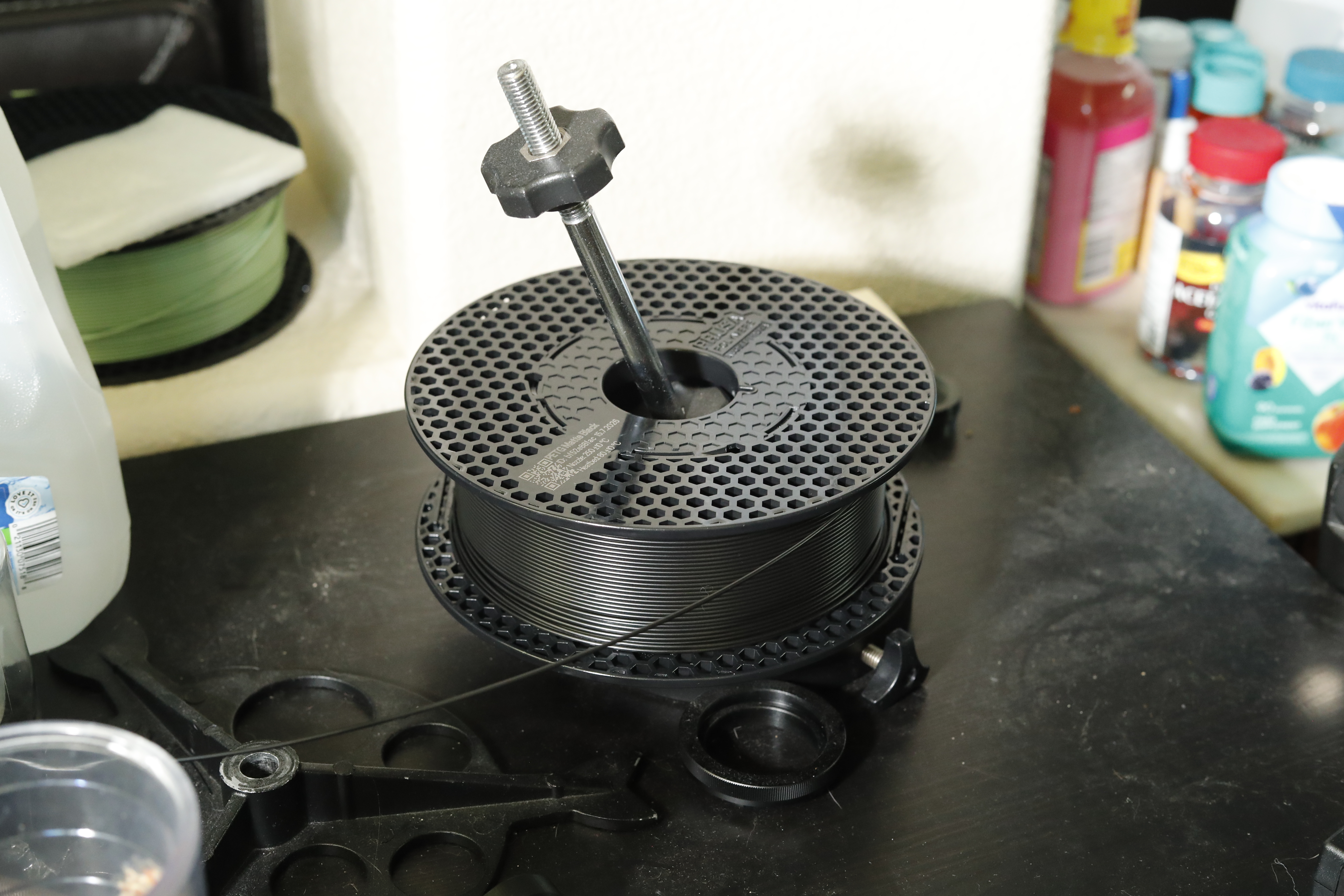
This works better than you might think: the spool can rotate (albeit with significant friction) around that central axle, the whole thing's sitting on a roughly 10 pound (4.5 kg) counterweight to keep it in place, and the printer's X axis and extruder drive have more than enough torque to turn the spool. It's not good for the X axis bearings, but this printer is a real beater and the X axis needs to be rebuilt anyways, so I didn't care.
Still, though, it's been on my to-do list for a while, and since I was already in this mood to care about putting the right hardware in something, I decided to see what a really high-quality spool holder might look like and try out some new design techniques.
One interesting thing about spool holders is they're actually a bit tricky to design, since 3D printer filament spools aren't that standardized. A 1 kg spool is usually about 200 mm in diameter, about 65 mm wide, and has a center hole that's about 55 mm, but all of those dimensions can vary by about a centimeter depending on style and manufacturer. Generally the 3D printing community has settled on two approaches: either use the center hole, with some kind of adjustable arbor on a spindle, or don't use the center hole and let the spool roll on its flanges.
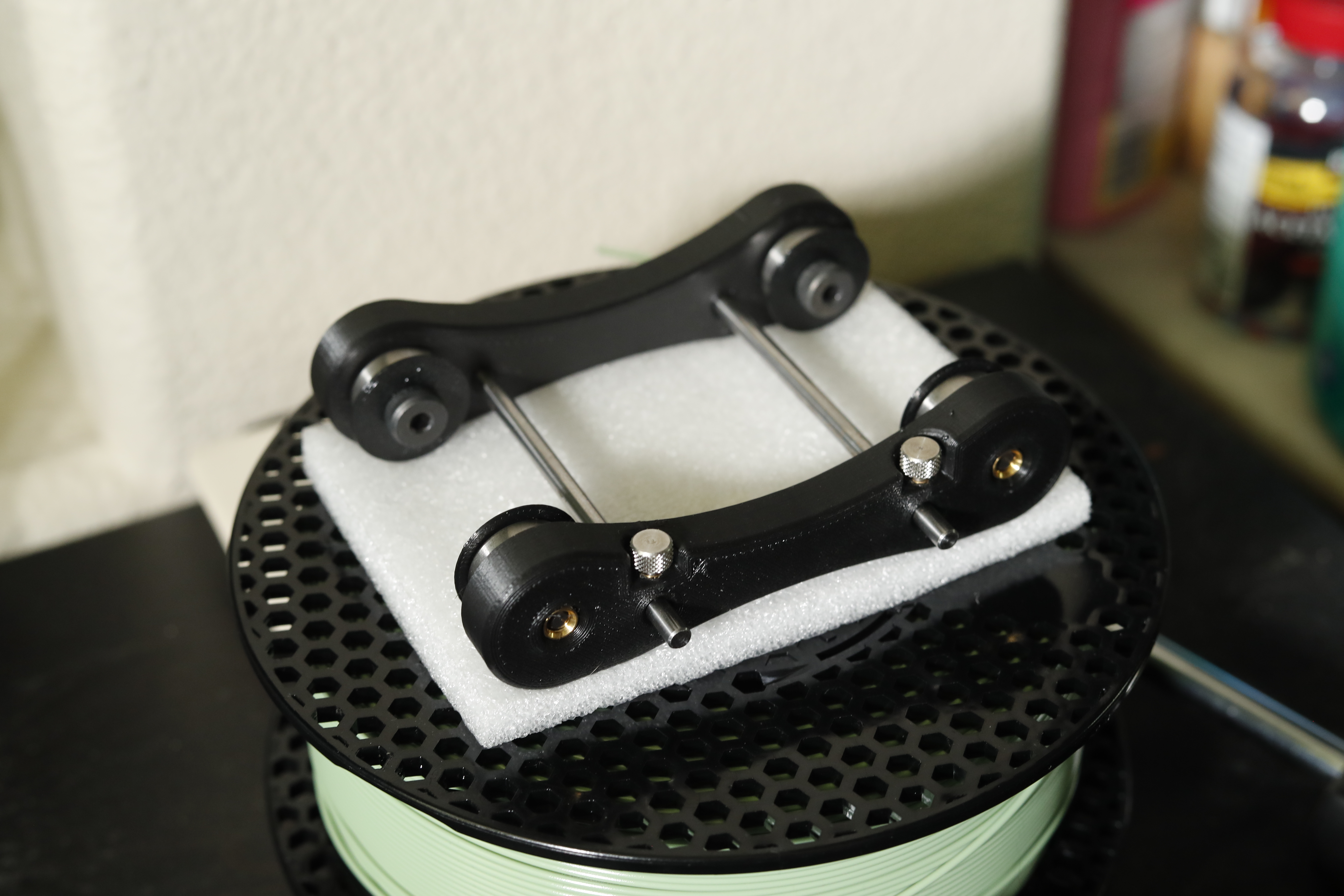
I ended up going with the second approach. This is a fairly common design where the spool is supported on four ball bearings and the holder can be adjusted to match its width. In this case, the width adjustment is handled by two 5mm steel rods the "moving" side of the holder can slide along, locked down with M3 thumbscrews. I've got the bearings on shoulder bolts with flanges to keep the spool centered, and all threaded connections in the build (including two small setscrews on the underside of the "fixed" piece that retain the steel rods) are done using brass inserts.
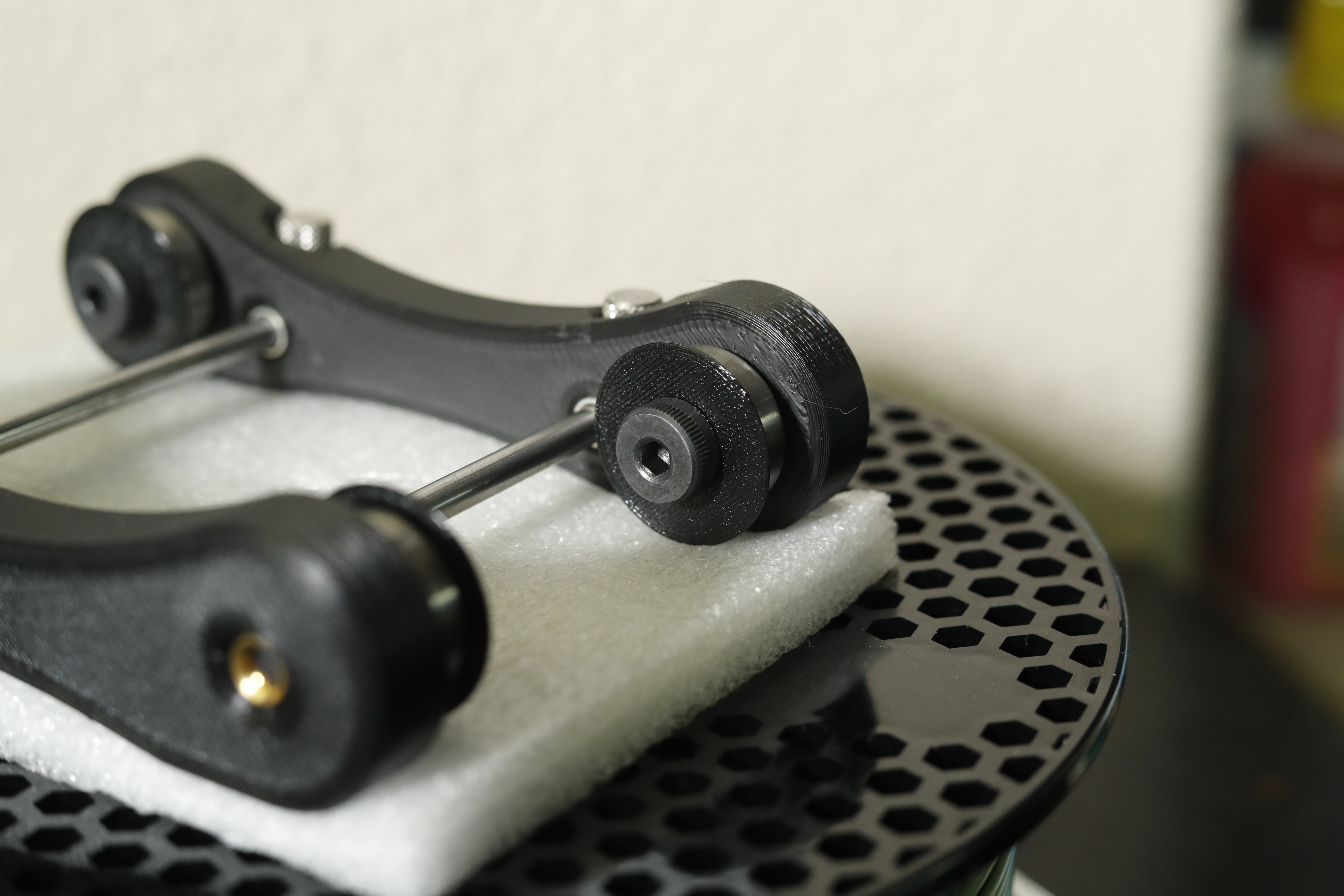
And it really does end up feeling premium. The thumbscrews for the width adjustment are a touch point, and having them go through brass threads rather than plastic threads is a huge difference for usability. The bolts for the bearings probably could get away with being threaded directly into the plastic, though if for whatever reason I need to disassemble this again later, it's going to be really easy. Similarly, using the shoulder bolts for the bearings makes putting those together much nicer than trying to jam them onto 3D printed bosses like in other similar spool holder designs I've used in the past.
They're also nice bearings. They are 608 "skate" bearings, but I got those trough McMaster as well, so they ultimately came from a well-known German bearing manufacturer and I gotta say these are the nicest skate bearings I've ever seen. Normally a dry 608 bearing will make a characteristic noise when spun with no load that anyone who's ever seen a fidget spinner will be very familiar with; these are completely silent. I've kept them un-lubricated in this application, of course, because they're under very little load (the spec sheet says they're good for a 140 kg static radial load, and a full printer spool weighs about 1.2 kg) and I don't want to risk contaminating the printer filament with lubricant.
In total, the BOM for this build is 34 parts:
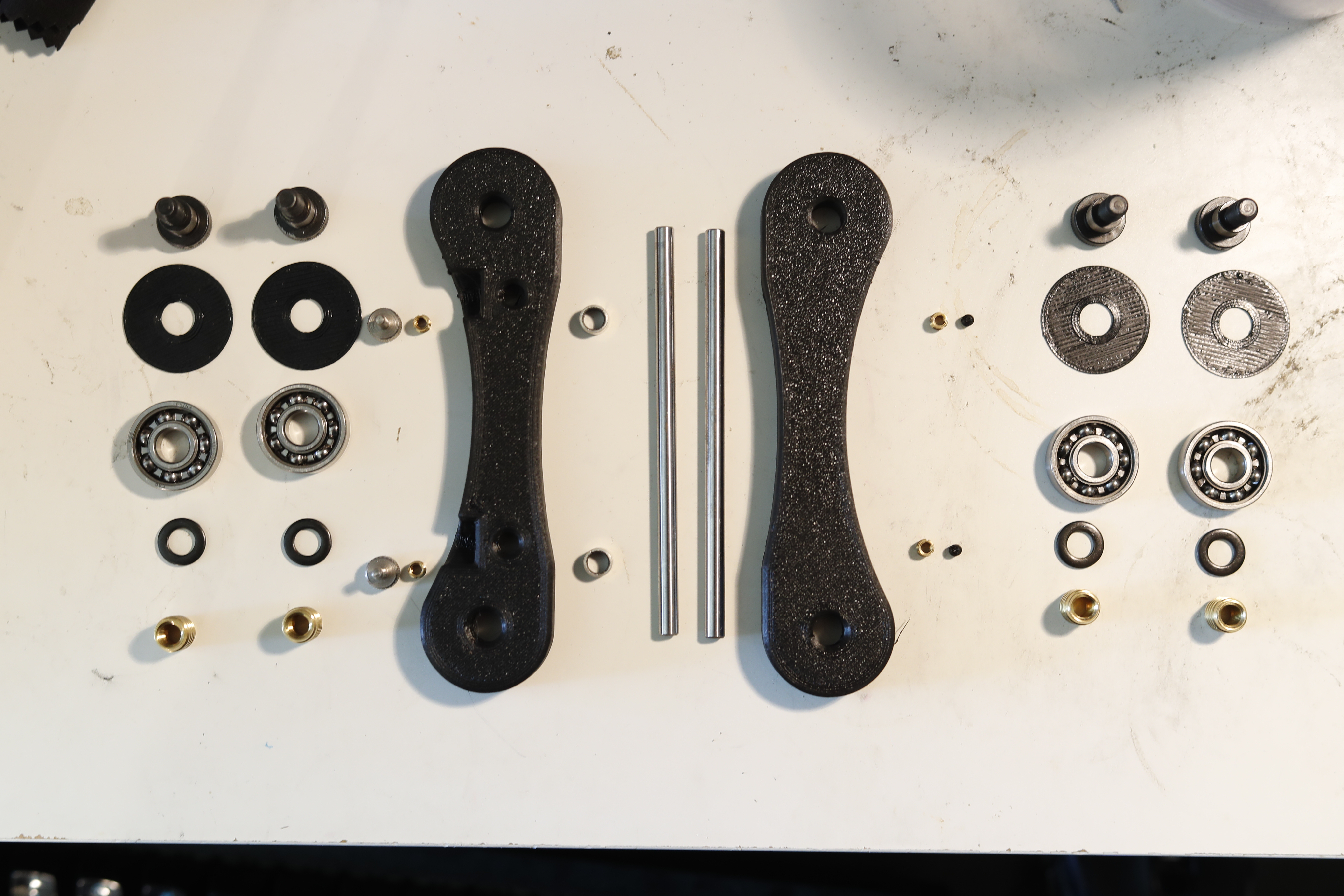
Unfortunately, as you probably guessed by now, the component cost is significant. This is a $80 spool holder. This is not a product anybody should actually have made.
On the other hand, though, it's a high-quality tool that will make my experience of building and prototyping in here a little bit nicer, and that's worth something.