Recently a bunch of my friends have been learning how to spin trance so I figured I might as well join in. These same friends have been turning me into the sort of person who listens to EDM and goes to the club in general, so it's been a neat thing to do to get more involved in the stuff we enjoy together.
It's been an interesting learning process. I've got a lot of experience with performing music, and DJing feels like it's really on the edge of what counts as "performing"; you do most of the work ahead of time in terms of song selection and planning (really, half the job seems like it's just "have good music taste"), and the actual live work of mixing transitions is certainly work, but when I do it I feel more like a technician than a performer. Maybe that's down to having a bit of sound tech experience as well. Who knows. The point is, it's fun.
This isn't going to be about the big picture, though. I was listening back to a session I recorded the other day, and this transition kept annoying me:
This is "Rain" by Plutian going into "Genesis" by Global Interference. The basic idea is we're trying to do a seamless -- or at least musically interesting -- transition between the two tracks, and at least in my opinion it really clunks here. Here's the previous transition, for contrast:
Conceptually, these are pretty similar. We have two tracks that are harmonically compatible, the outgoing track has a buildup and drop, and I'm cutting over on that drop. But one works and one doesn't.
Let's start by looking at why it seems like this should work. In both cases, we're at a good point in the track for a transition. In both cases, we're moving between harmonically related keys: the bad transition is D major to A major (some might call this 10B to 11B), and the good transition is E minor to D major (some might call this 9A to 10B). This is usually a recipe for success. Keys that are a perfect 5th apart, or relative major / minor, or both are usually easy to transition between.
My usual line on music theory is that it doesn't directly tell you how to write something that sounds good, but it can tell you why something sounds bad. So, music theory, why does this sound bad? Let's chart it out.
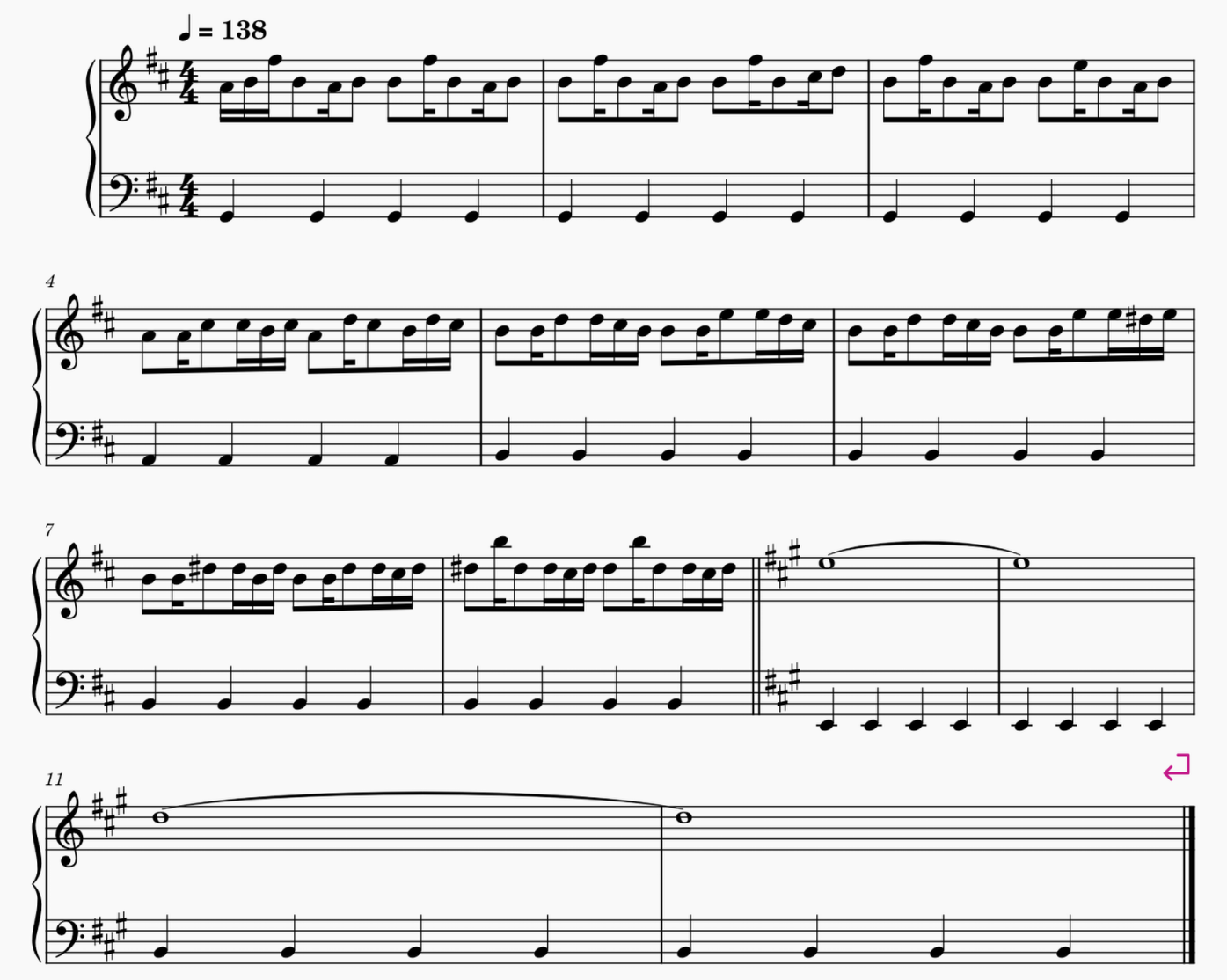
This isn't the best transcription in the world, but the important part is that it has the same problem as the original mix:
There's something happening in mm. 7–8 that really screws up the key change. I'll go ahead and chart out just the melodic structure here so we can really get into it.
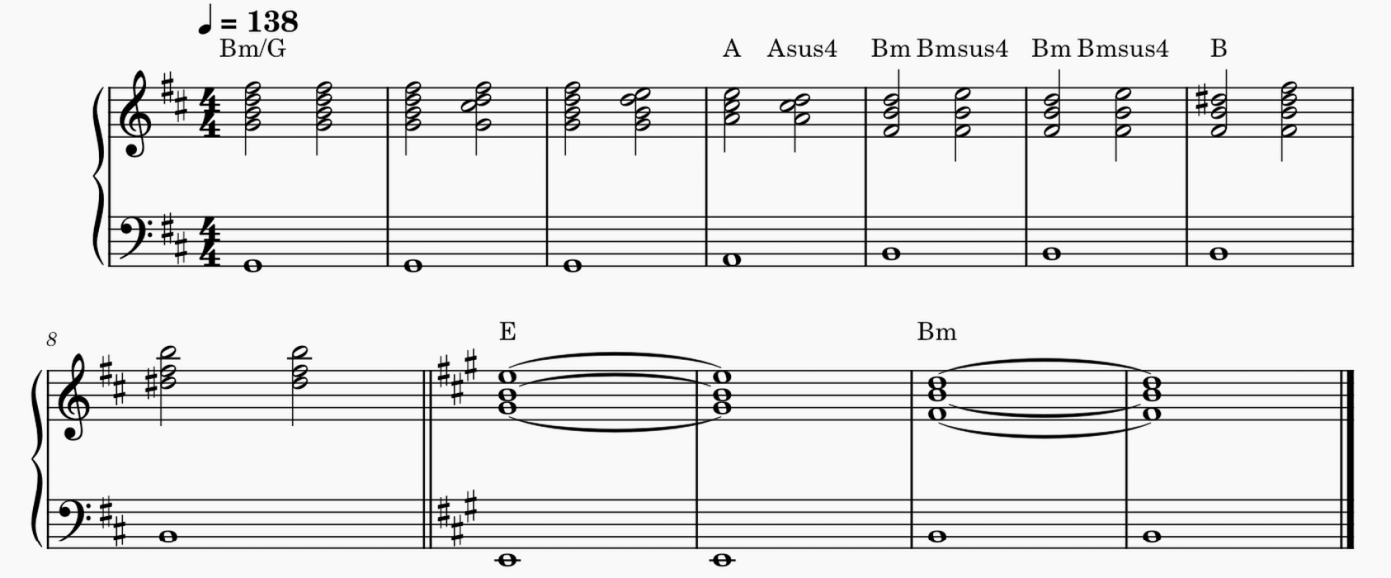
At this point, I can definitely see what's going on. In the outgoing track, we're actually tonicizing B major for a second. In Roman numeral analysis, this progression is roughly gonna be IV7 - V - vi - VI, which is definitely a thing you can do -- the original track ends up back on a D major chord after this, so we just have the D♯ in there for a bar and then it resolves back to the key of the song that you've been listening to for the past five minutes.
When we switch over to "Genesis" at bar 9, though, that's on an E major chord, so the progression ends up going IV7 - V - vi - VI - II (disregarding the key change). The funny thing is that this does actually almost work. We sort-of cadence in E major at the end there, and you can do that if you commit to it:
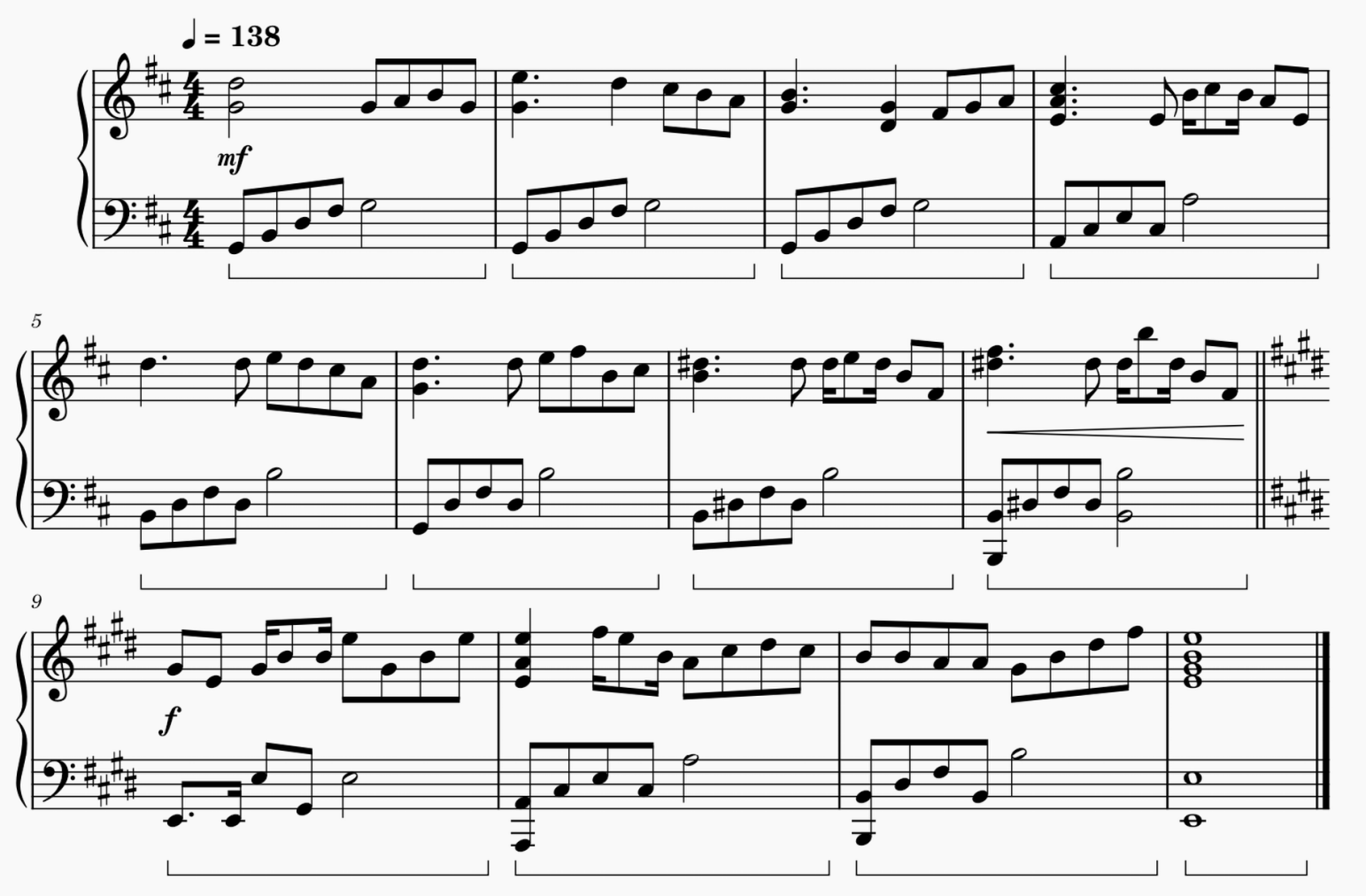
This is exactly the same chord progression until measure 10 (after the key change), but this one sounds pretty reasonable. There are two big differences: one, we end up in E major at the end and really hammer that in with a I - IV - V - I progression, and two, we make the rhythm more complex across the key change. Going to E major instead of A major means we keep the D♯ in the key signature, and the rhythmic structure makes it a little more obvious that yes, you did just hear a key change there, you didn't imagine it.
In the original progression, by contrast, we lose a bit of energy across the transition, which gets the listener a bit on edge that something weird happened, and then 2 bars later we hit that B minor chord, with the D♮, and it screws everything up. Perhaps you kinda think it is going to E major, and then Bm isn't in E major, so it feels out of place; generally speaking a key change puts you on the I chord in the new key, but for some reason the incoming track is on the V and then goes to ii.
So really the tonality isn't established well in either track at the transition and it ends up being a bit of a mess. What can we do about it?
Well, one option is to commit to ending up in E major. Here's a transition to "Innerspace" by Factor B (pitch shifted appropriately) at the same spot:
Why does this work better? Well, I've made sure to pick a section of "Innerspace" where the energy is high and the key is really firmly established; it starts with a minute or so of relatively sparse harmony without a strong beat, and that stuff wouldn't work. E major is one of the places you can go from that B major chord, and in this case it's obvious from the drop that that's the place we went.
That screws up my playlist, though. I wanna play "Innerspace" later, and I wanna play it in the original key of D major so the sample doesn't sound weird. The other, simpler option is just to end "Rain" literally anywhere else and start "Genesis" literally anywhere else, where we can take advantage of the assumption that going from D to A will just work. If I tweak the relative offset of the tracks by 16 bars, I can do the transition in a spot where both of them do have that strongly established tonality, and it pretty much works fine:
I could nitpick this still, but it definitely sounds a lot better. This is how I'm planning to do it when I record a new version of this set.