First, an update on the logging off business: Uh, I have a morning routine now? Never used to be able to do that.
Overall I'd say it's going pretty well, I've been way more productive, and even when I'm goofing off it's on stuff that's at least marginally useful (speedrunning, researching random tangents, writing silly computer programs) instead of scrolling the feeds, which isn't.
Anyways, this is a post about some objects I pulled out of storage, and here they are:
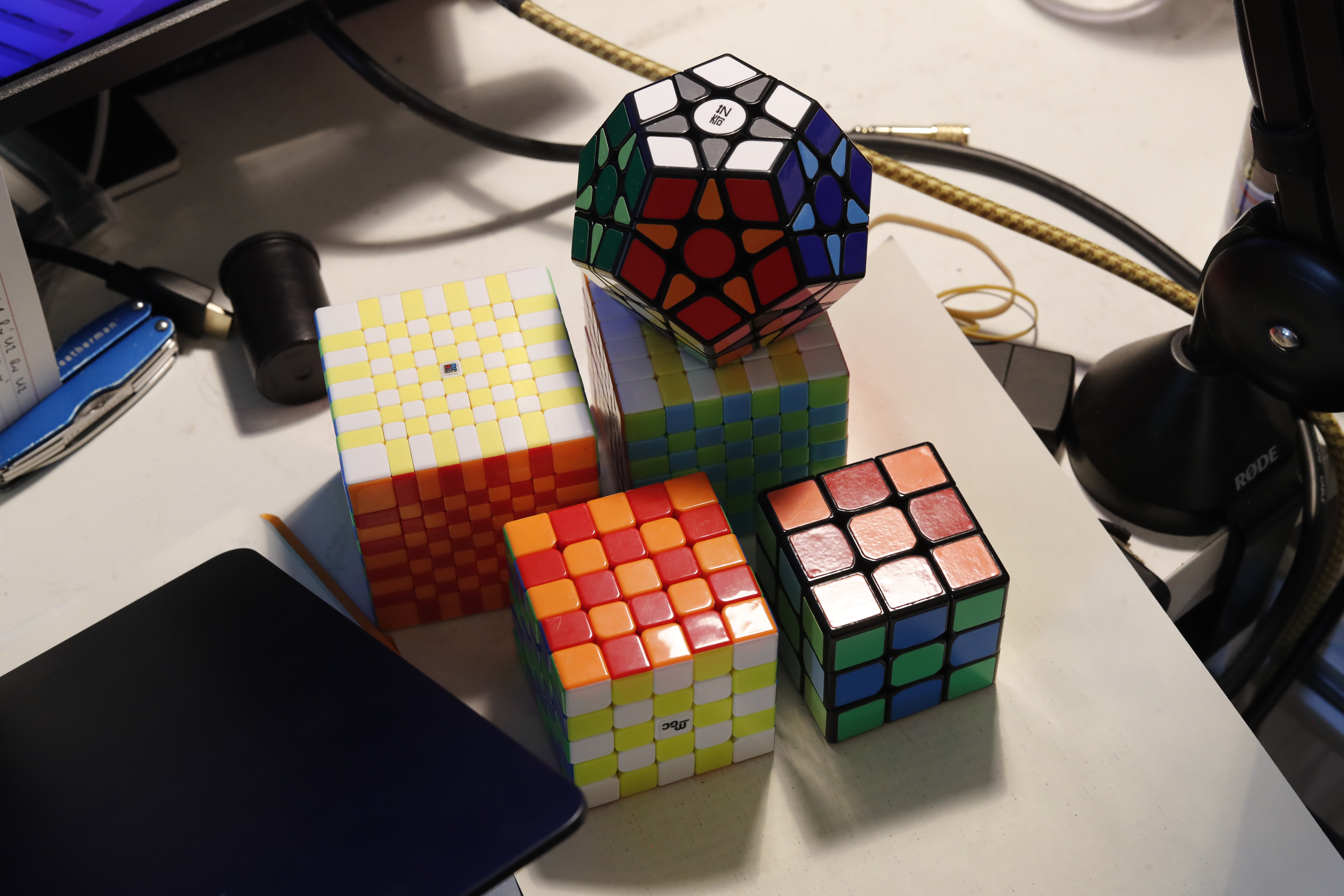
I used to be a bit of a speedcuber in high school. I wasn't all that good at it (I think my best 3x3x3 time was a hair under 30 seconds), but it was a lot of fun, and I'm kind of looking at picking it back up again.
As you can see from the photo, I didn't limit myself to the normal 3x3 cube. I got interested in the big cubes pretty early on, and the neat thing is that each size really has its own character. The 5x5 is pretty close to the 3x3, just with a little bit of "the big cube stuff"; the idea with these is that you solve them by "reduction", first getting all the centers put back together (the innermost 9 pieces on each face), then get the edges lined up (in any orientation), and now the puzzle has turned into a slightly unwieldy 3x3 and you can solve it in the usual way. Here's a "reduced" cube ready for the final 3x3 solve:
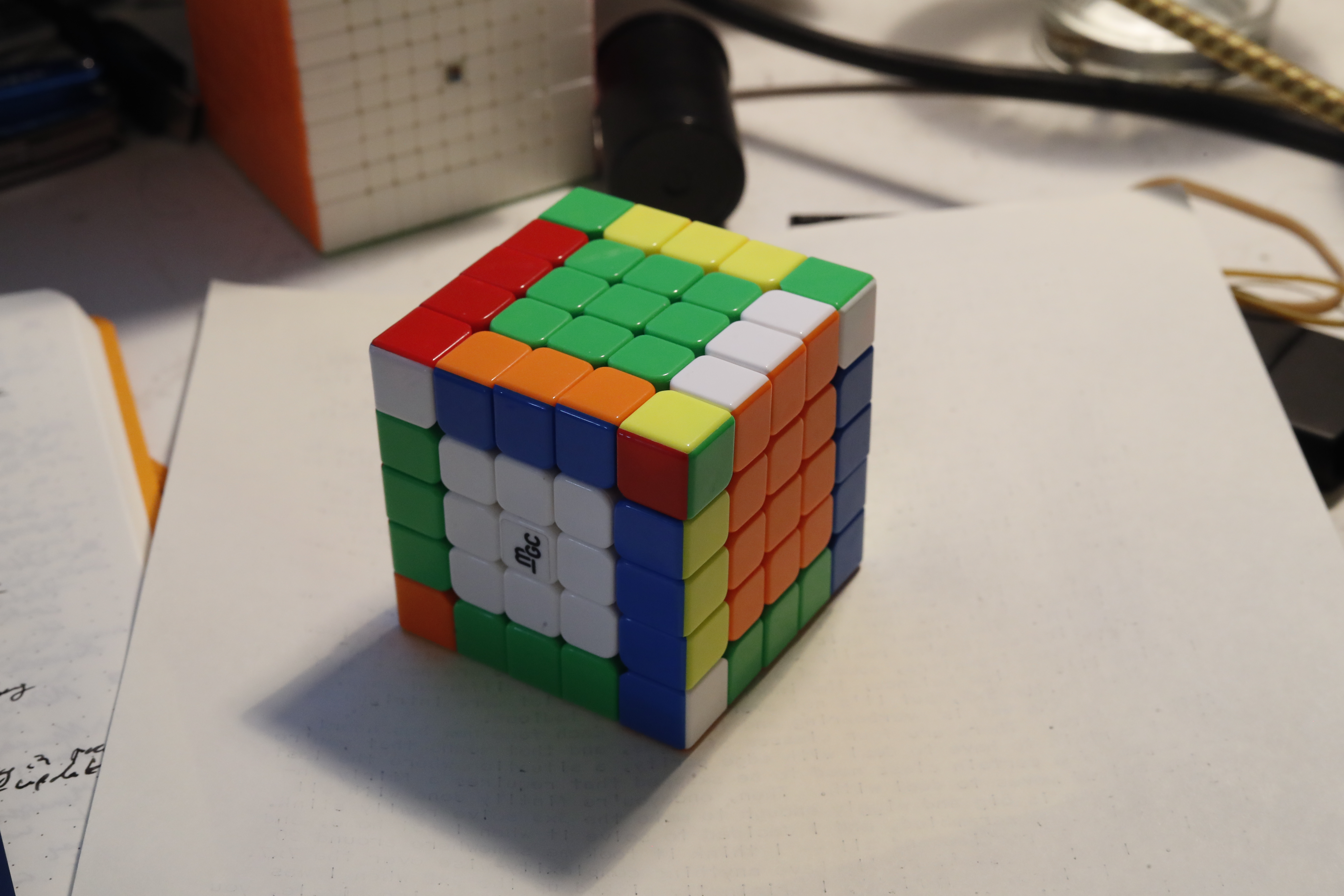
I find this to be a pretty fun process. The edges have variety because you use a slightly different technique for the last 4, the centers are largely intuitive and have some neat tricks, and then the 3x3 solve has less impact on your overall time so it's less of a drag if your 3x3 technique stinks.
So the 5x5 has a bit of that new stuff. The 7x7, of course, has a lot more of it: each face now has 25 centers instead of 9, each edge has 5 sub-edges instead of 3, and there are now multiple different classes of piece to deal with. The "inner" pair of sub-edges can't be swapped with the "outer" pair, so they're really separate things, and there are now 5 different classes of centers, some of which move in ways you don't get on the 5x5. I think it's a nice balance. The inner pieces are more interesting and there are more of them, but it's not so much to be overbearing and tedious.
The 9x9 is overbearing and tedious. Each face now has nearly fifty centers. There are four classes of edges, and that means you're almost certainl to have to deal with "edge parity", a situation where the last two edges of a certain class need to be swapped that requires a fairly annoying set of moves to deal with. Then, once you're finally done with all that, the cube is big and wiggly enough to make the 3x3 solve really stink. I had put it away scrambled, and I decided to solve it when I got home with it the other day, and (being out of practice and all) I think it took me somewhere around 90 minutes.
Also, unlike the 7x7 which adds the knight's-move centers, the 9x9 doesn't really add any truly new piece classes. The edges are always all the same, and centers fall into four categories (center, vertical and horizontal axes, diagonals, everything else) which are all covered by the time you get to the 7x7. It's more, but it's not harder.
If I remember right, I originally picked up the 9x9 when I was working in an office five days a week. It's a great multi-session puzzle, you work on it a bit here and there and it's a fun conversation starter when people walk by your desk. Doing it in one sitting is a slog. There's a reason the official timed events stop at 7x7, I guess.
Anyways, I'll go ahead and address the dodecagon in the room. That's called a "Megaminx" (don't ask me why), and it's another way to extend the 3x3 cube. Instead of adding more types of pieces, the Megaminx just adds more pieces; a 3x3 cube has six centers, twelve edges, and eight corners, whereas this has twelve centers, thirty edges, and twenty corners. The thing that makes it work is that the local topology of every piece is the same; each corner is adjacent to three edges, each edge is adjacent to two corners and two centers, and the only difference is that a center is now adjacent to five edges instead of four. It turns out that the same moves you use to solve the first two layers of a 3x3 work the same here (it's just four layers instead), and then the last layer technique is a bit different but it's not too hard to pick up.
Accordingly, it feels like a longer version of a 3x3 solve, instead of a bunch of unrelated stuff and then a 3x3 solve like on the big cube. It's a nice bit of variety when I get tired of solving centers on the 9x9 or get peeved by complicated last-layer algorithms.