An update from last week: the new roof motor is in the car, and it works fine. Now on to your regularly scheduled programming.
So I really don't have space for another typewriter. As of last month, I didn't really have the budget for another typewriter. And yet, sometimes, the Internet asks you questions like "would you like to buy an example of the smallest mass-produced keyboard typewriter for a very reasonable price?".
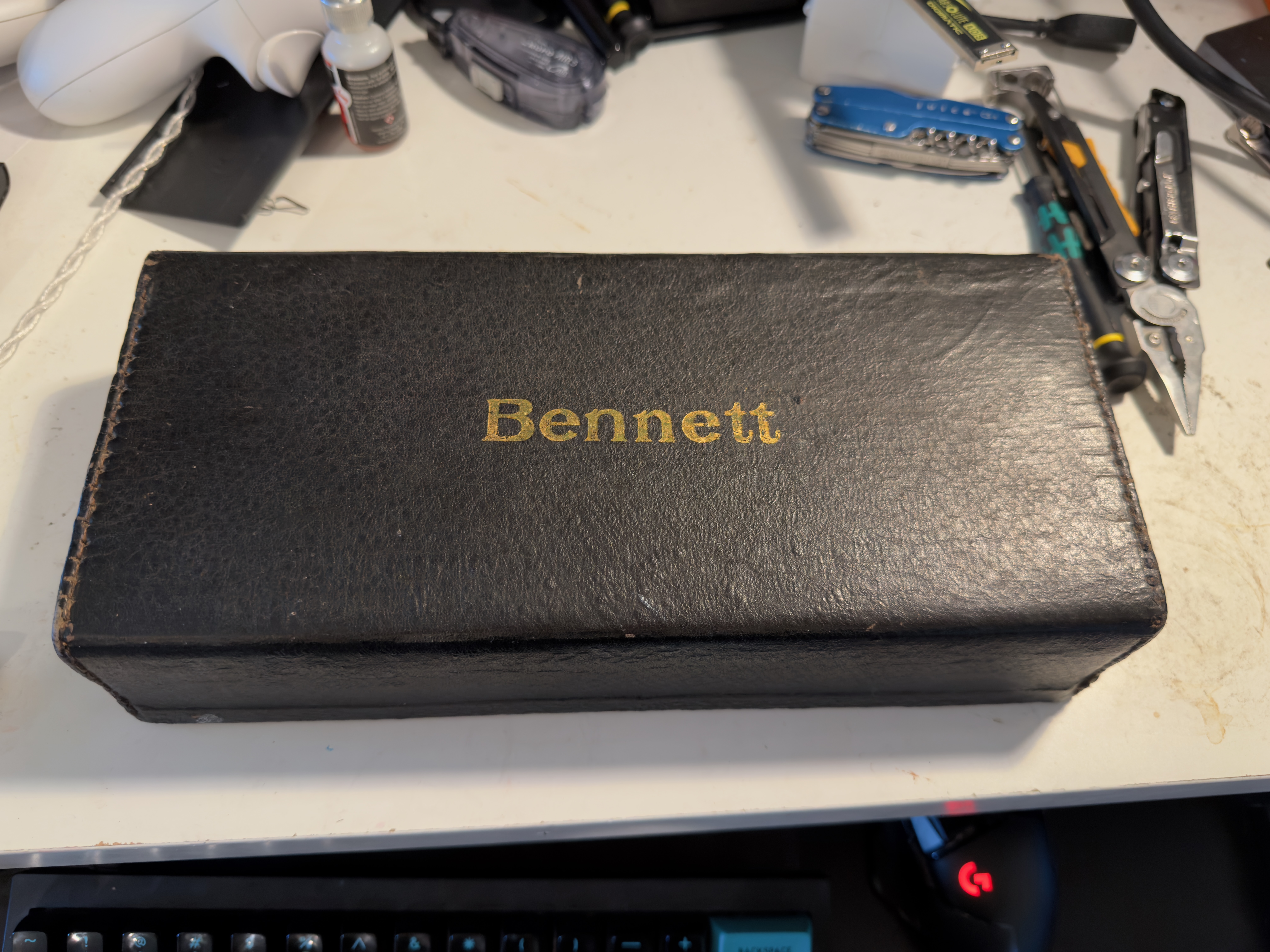
So here it is. The leather case is in remarkably good condition for being 116 years old.
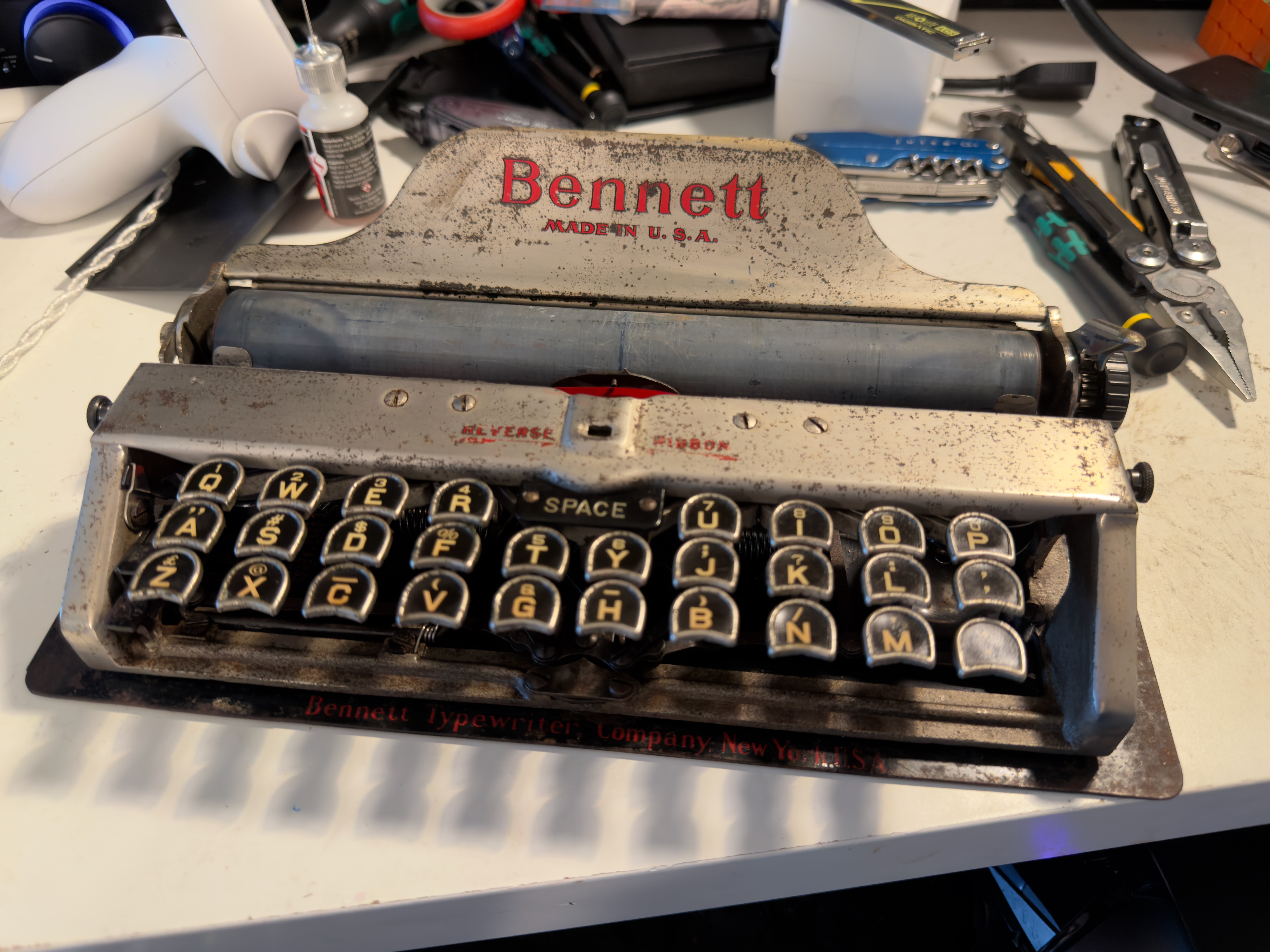
Taking that off, we find the machine itself. As is common for ultra-portable typewriters, the carriage is just wide enough to take a sheet of 8.5" paper. The paper table in the back folds out to save room in the case.
We can also see the first obvious sign of compromise in the typewriter's design: the keyboard layout. This is what's referred to as a "3-bank" keyboard, meaning there are three rows of keys, each of which can type three different characters via the use of two shift keys, which in this case are two little metal flags on the extreme left of the keyboard:
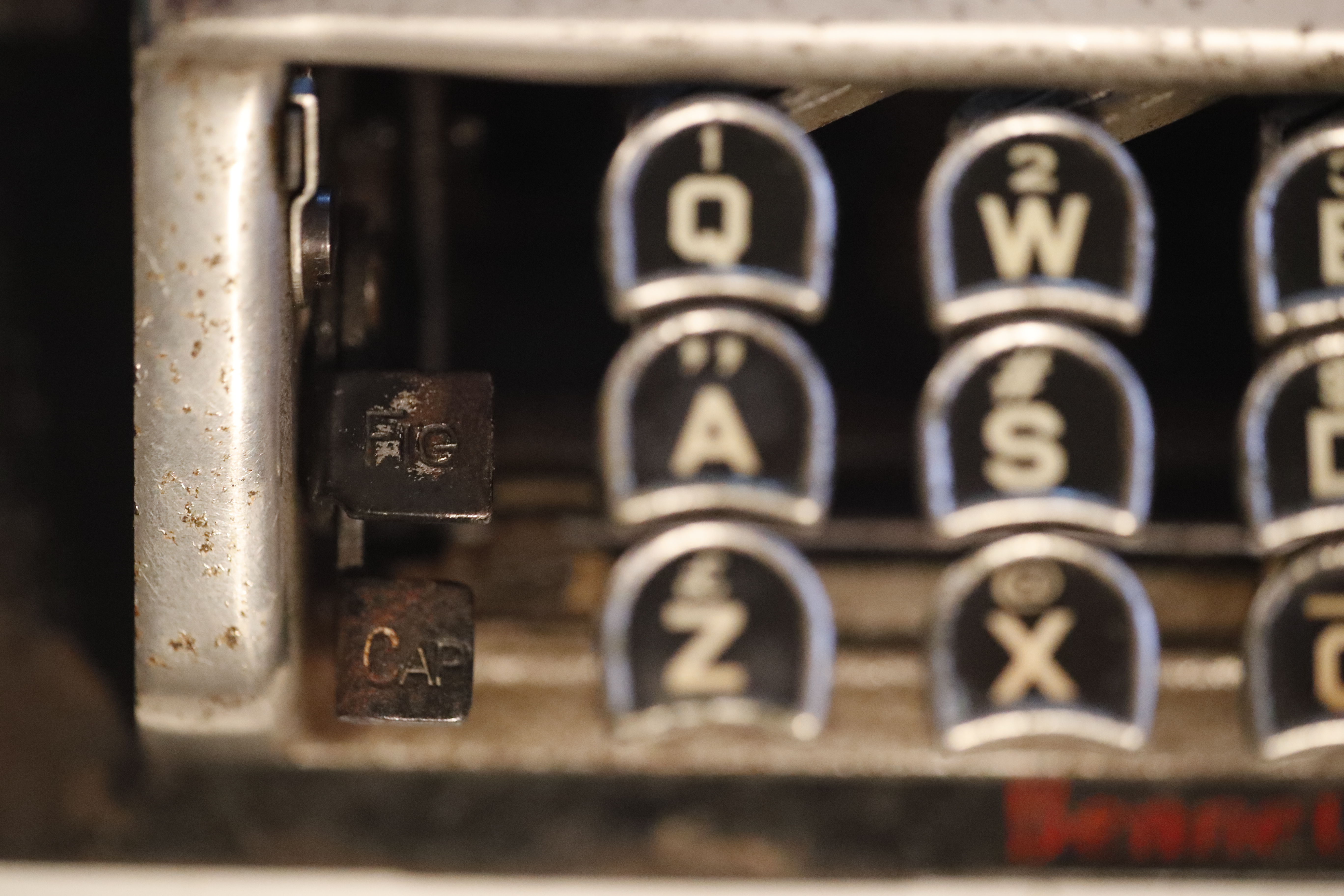
For comparison, most typewriters (and all modern computer keyboards) are of the "4-bank" type, having four rows of keys, each of which can type two different characters via the use of one shift key.
Three-bank keyboards are relatively common, especially on pre-WW1 typewriters; more well-known examples are the Hammond, Blickensderfer, Oliver, Corona 3, and (my personal favorite) the Underwood 3-bank portable. The concept actually lives on in today's "40%" computer keyboards, which do the same trick of saving space by using additional shift keys to access numbers and symbols.
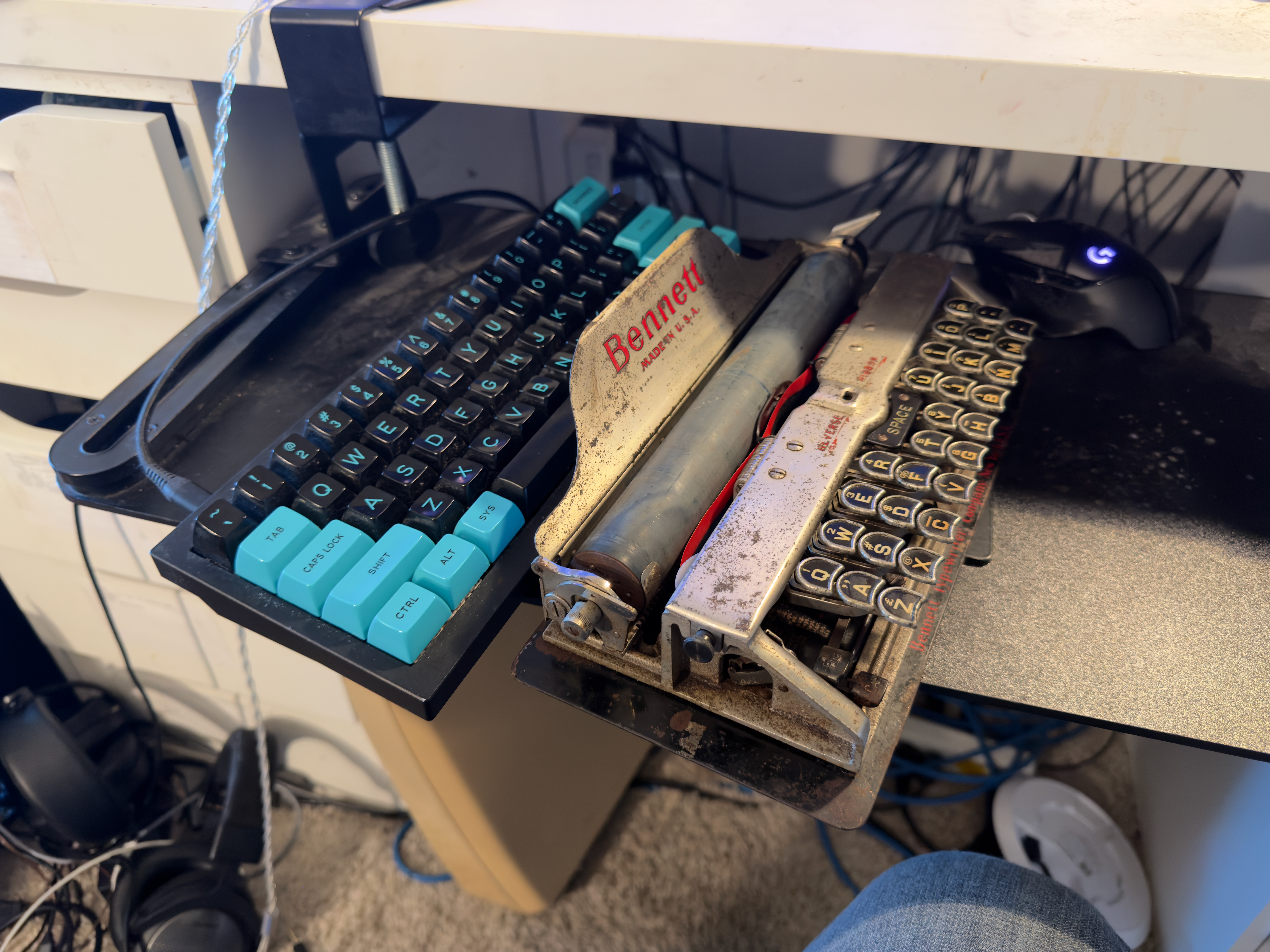
Speaking of computer keyboards, here's the Bennett next to my 60% keyboard, and they really are about the same size. This shows another compromise: the keys on the Bennett are tiny. Standard computer keyboards (and most typewriters) have their keys centered 3/4" (19mm) apart, and while the Bennett does manage that on the horizontal axis, the rows are only 1/2" (13mm) apart. It feels noticeably cramped.
In fact, the design of the typewriter means that it's possible to press multiple keys in the same column without affecting printing (the highest key is always selected, so pressing QAZ prints "q" and pressing AZ prints "a"), and the manual for the typewriter recommends that you hold your fingers in a flat position to take advantage of this. My experience so far is that it is possible to 8-finger touch type on this keyboard with a bit of practice. It feels weird.
Speaking of feeling weird, here's a cool trick the Bennett can do: the carriage comes off without tools.
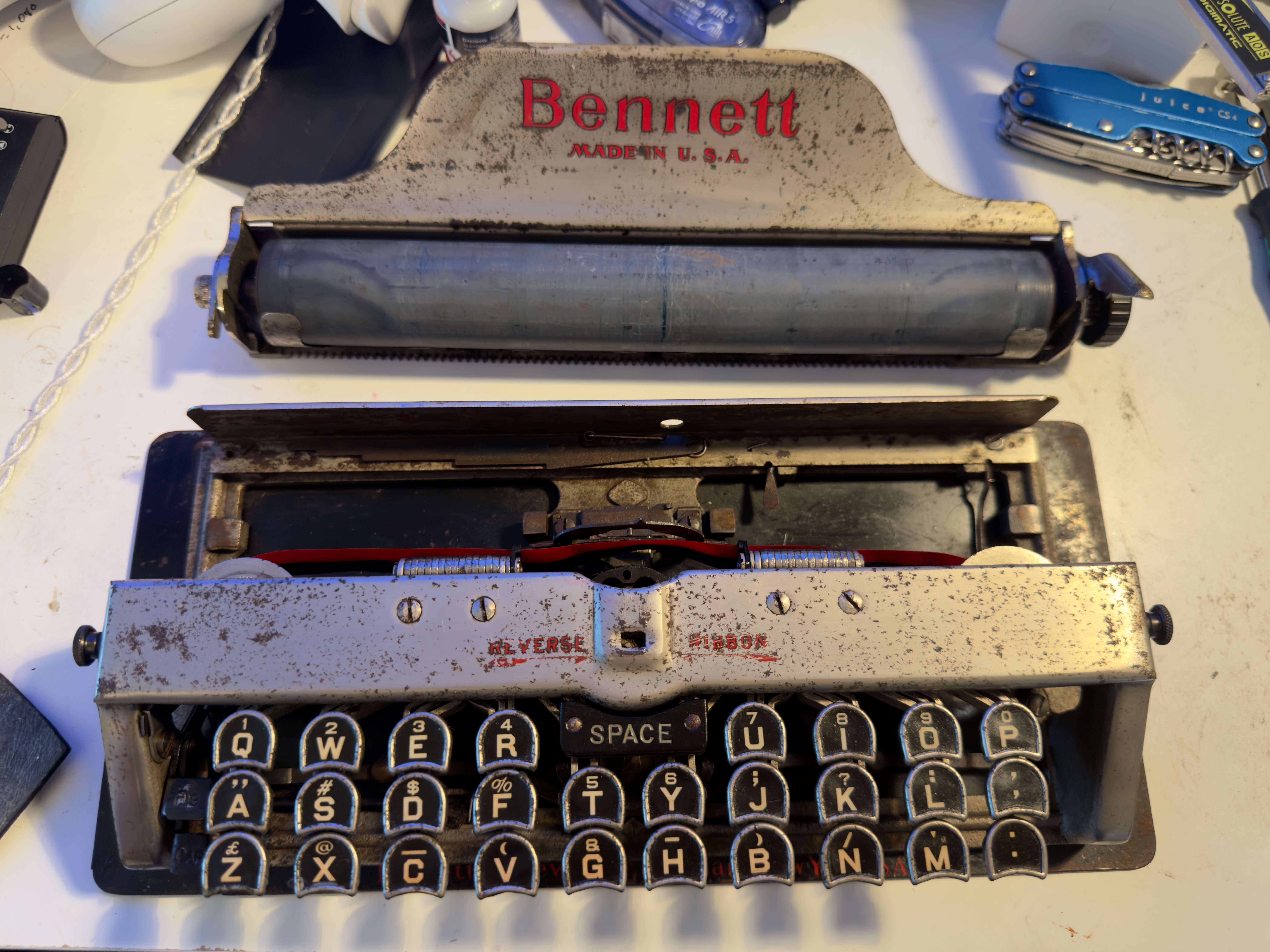
All you do is disengage the lever on the left that controls the left margin (rather than being a moveable stop, you get your choice of 5 different margin positions; this is actually pretty clever in its implementation and suitable for most typing) and pull the carriage out to the right. If you're not a real nerd about typewriters, you might not realize the massive red flag that implies. See, on most machines, you can't do that, because there's (at least) one more step: disconnecting the drawband.
Usually, the carriage on a typewriter is spring-loaded, so that as you type, spring tension is released to pull it along to the left; when you return the carriage, the spring is rewound for the next line. This has a lot of advantages: for one, the carriage is always registered against a stop on the escapement, so it's in a known consistent position, and more importantly that means none of the energy of the key stroke is used to move the carriage.
The Bennett's carriage, however, is not spring-loaded. It's completely floating in the machine. This means you can bump it around and lose your typing position, and it also means that part of the key stroke is dedicated to moving the carriage along.
"Ah, I see I have a question. Uh, okay, I see the whole audience is asking the same question: Wouldn't that suck?"
- Cathode Ray Dude, Camcorder, More Like Camcord-RW (It's A Disc Joke)
You better believe it does! The typing action on this thing is horrible. Each key takes a large and inconsistent force to depress, and on the whole it feels like you're just kind of mashing the type against the paper rather than the nice snap you get out of most machines. If you miss a stroke, which is pretty easy to do, there's no backspace, so you have to fiddle around moving the carriage back and spacing over to get back to where you were.
It does, however, type. I suppose I've left you long enough without a type sample, so here's one from when I got the ribbon working the other day:
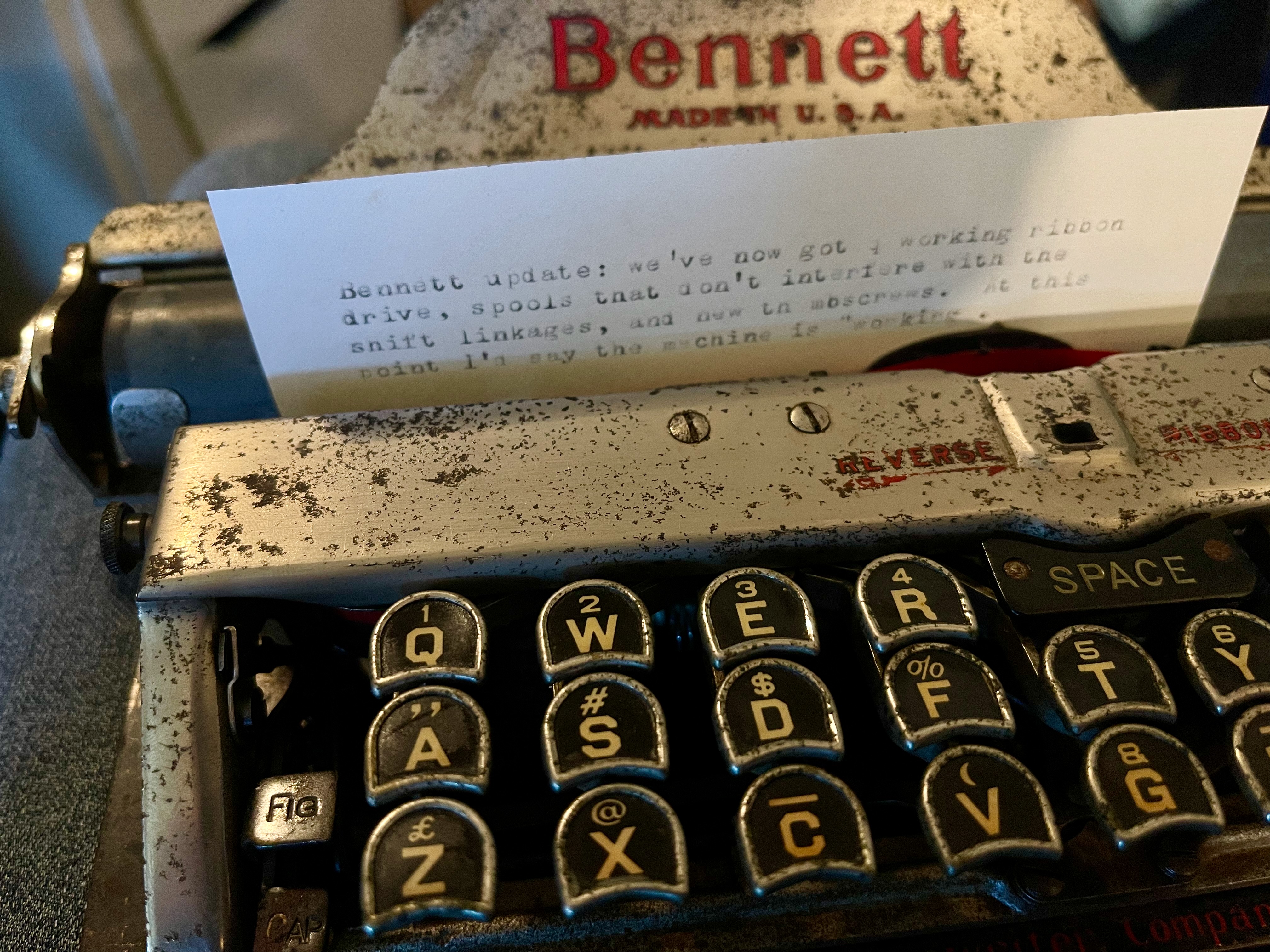
This looks pretty bad. A lot of that is actually the ribbon's fault; this is a cheap Amazon special that I happened to have spare. New ribbons are on order. I'm looking forward to when I have a good ribbon on here and can get a proper look at the typeface. It's pretty close to the "standard pica" we usually see on typewriters, but there are some subtle differences from later implementations of the font.
I should pause here and clarify that I think the Bennett is a good piece of engineering. They packed a lot of features into here, and it's remarkable that the only "standard" features missing from this machine that can fit in a big coat pocket are a backspace key and a proper carriage return lever. There's a lot of effort that went into making this thing work at all.
Anyways, as you might be able to guess from the text of that type sample, I had a bit of trouble with the ribbon situation. Let's look inside the machine.
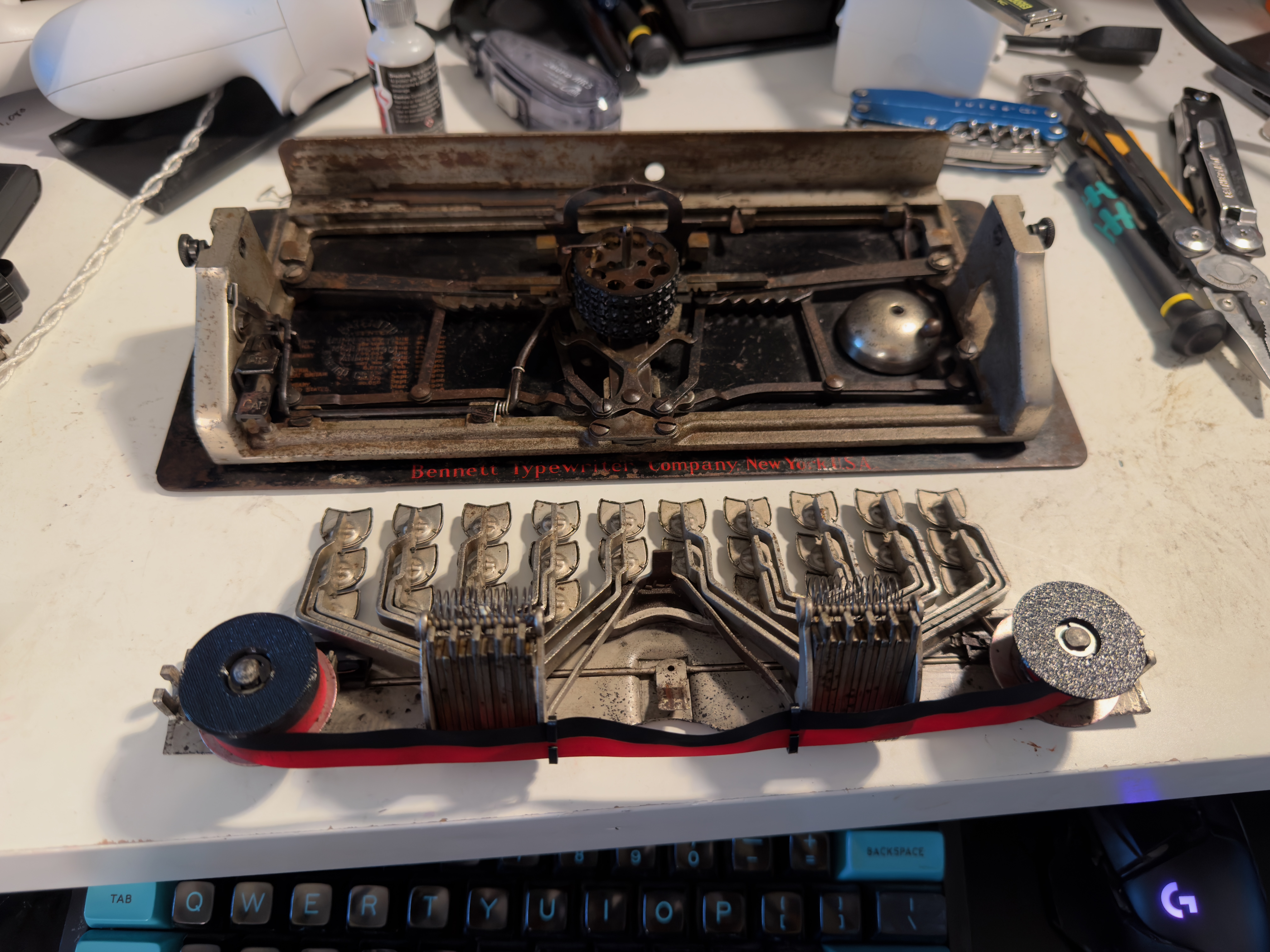
This whole top section with the keyboard and the ribbon comes off as a unit. This also happens without tools; the two thumbscrews at the sides of the keyboard can be loosened (sadly, I didn't get them with the typewriter, these are modern replicas) and the assembly lifts off.
The mechanics of the typewriter are fairly simple. It's a single-element typewriter, with all the characters on that cylindrical piece in the center of the machine. When a key is pressed, the element rotates to the correct position and presses forward into the paper, and the shift keys raise it to select one of the three rows of characters.
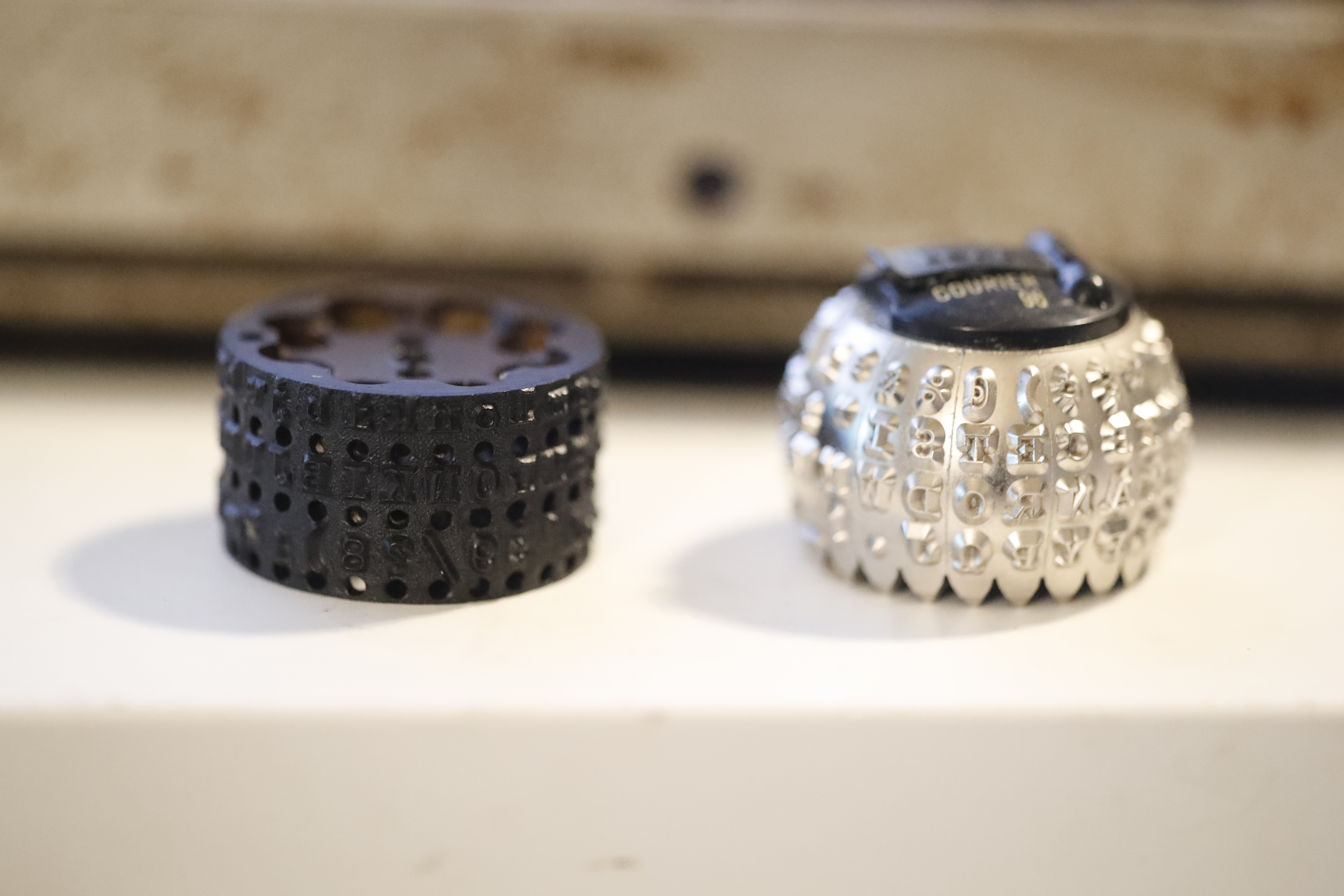
This is similar in concept to the venerable IBM Selectric design, although the Selectric's implementation is much more sophisticated. On the Bennett (and similar machines like the Hammond or Blick) the characters are arranged on the element in keyboard order. This means that some commonly-used characters like "a" or "o" require the element to rotate nearly to the limits of its travel, whereas the rare "y" is only one position away from neutral. The Selectric uses some very complex linkages to allow the characters to be placed arbitrarily on the element, which is more mechanically efficient on the print stroke (though it is an electric machine, so who's to say how important that is).
Anyways, you probably noticed that there are a couple obviously 3D-printed parts on the ribbon mechanism right now. That, unfortunately, will continue. I'm missing a couple pieces from the ribbon spools, and the stock ribbon guides are beat to crap.
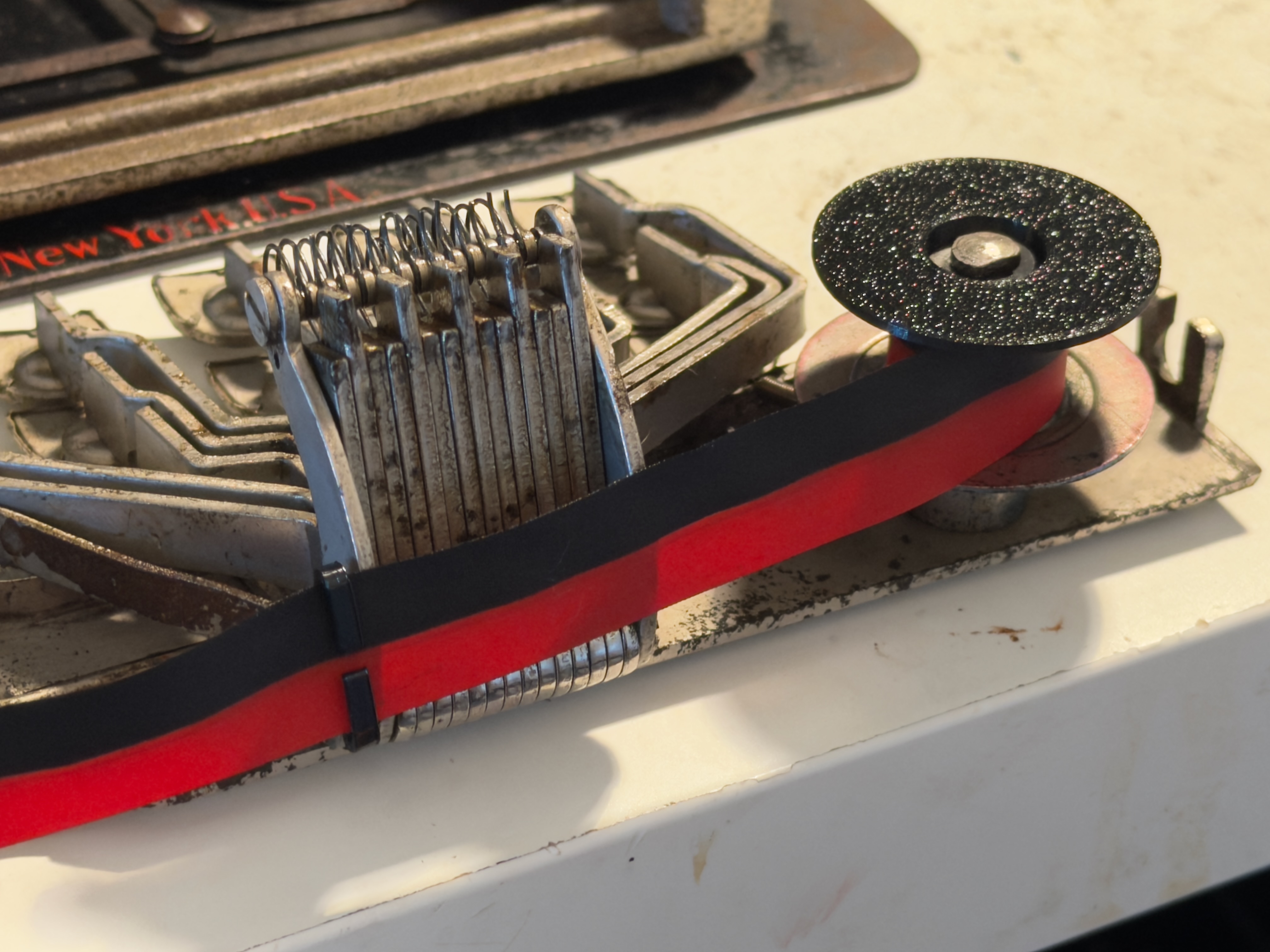
An advantage, though, of making these ribbon parts are that I can adapt the machine to accept 1/2"-wide ribbon for testing. It's supposed to take 7/16", and that's what I have in the mail, but it was pretty simple to print up spools and ribbon guides for a 1/2" ribbon. I also had to replace a missing spring for the ribbon drive to work continously, but it seems like it's pretty happy now.
I don't know if I've said it on here before or not, but my philosophy with this kind of project is always that I'm a toolsmith, not a curator. The machine was non-functional, and I've repaired it using the tools, parts, and techniques I have available to me. It's easy to say "this 116-year-old typewriter should be in a museum", but in my mind that can just as well happen later. This typewriter has not exhausted its useful life, and perhaps someday it can be in a display case somewhere with a note explaining that it was in use through at least 2026.
And that's cool, darn it. This typewriter wasn't even really built to last in 1910 -- the Bennett was explicitly marketed as a budget option -- and yet it still works well enough to serve its original purpose. I haven't yet typed up a whole letter on here, but I certainly will once the new ribbon gets in next week.
One last funny thing to round up: This machine is serial number 12,872, putting it close to the start of the production run. According to Typewriter Database, the range on these is 11,501 through 35,284; that's a little less than 24,000 produced, so it's no surprise they're fairly rare today. While I was writing this post, I went on there to look for photos of other machines showing the serial number, since I wasn't sure where on the machine it was located and wanted to get some idea of which year it was made.
Turns out, the lowest serial for a Bennett listed on TWDB is... #12,872. This exact one! Apparently the person I bought it from (who is selling off a large inherited collection) has been uploading images and serials as they go. So I guess this is, in fact, the oldest Bennett on record. Suppose I should be a little careful with it, huh?